If your business builds software in Sweden, you've likely hit the same wall: development looks great in testing, but getting it live, stable, and scalable is a different challenge entirely. That gap between writing code and running it reliably in production is exactly where DevOps Sweden services come in. In 2026, Swedish companies across fintech, healthtech, e-commerce, and SaaS are turning to DevOps practices to ship faster, reduce downtime, and build infrastructure that grows with their business. This guide breaks down everything you need to know, from CI/CD pipelines and containerization to cloud provider choices and pricing, so you can make confident decisions for your digital operations.
DevOps is the practice of combining software development (Dev) and IT operations (Ops) into a single, continuous workflow. Instead of developers handing off code to a separate operations team and waiting days or weeks for deployment, DevOps automates the entire process. Code gets tested, built, and deployed automatically, with monitoring in place to catch problems before users notice them.
For Swedish businesses, this matters for a very practical reason: speed and reliability directly affect revenue. A slow deployment process means slower feature releases. Manual infrastructure management means more human error. And when your application goes down, Swedish customers don't wait around. They move on.
The traditional model, where development and operations work in silos, creates bottlenecks that cost companies time and money. DevOps eliminates those silos. It creates a culture and a set of tools that let your team deploy code multiple times per day with confidence, roll back instantly if something breaks, and scale infrastructure automatically when traffic spikes.
Swedish startups and SMBs are adopting DevOps in 2026 not because it's a trend, but because it's become the baseline expectation for any serious digital product. If you're building a web application, a mobile app, or an e-commerce platform for the Swedish market, DevOps is the engine that keeps it running. For a deeper look at how modern tech stacks support this, see our guide on how to choose the right tech stack for your web project.
Sweden is one of Europe's most digitally advanced markets. Stockholm alone is home to more unicorn startups per capita than almost any other city in the world, according to StartupBlink's global ecosystem rankings. That concentration of tech-forward companies has created strong demand for professional DevOps services across the country.
Swedish businesses face a specific set of pressures that make DevOps particularly valuable. GDPR compliance requires careful data handling in cloud environments. The Swedish market expects high application performance and uptime. And competition from UK, Dutch, and Finnish tech companies means Swedish businesses can't afford slow release cycles.
Industries driving the most DevOps adoption in Sweden right now include:
Compared to the UK and Netherlands, Sweden's DevOps adoption is strong at the enterprise level but still growing among SMBs. This creates an opportunity: smaller Swedish companies that invest in DevOps now gain a meaningful competitive advantage over peers still relying on manual deployments and shared hosting.
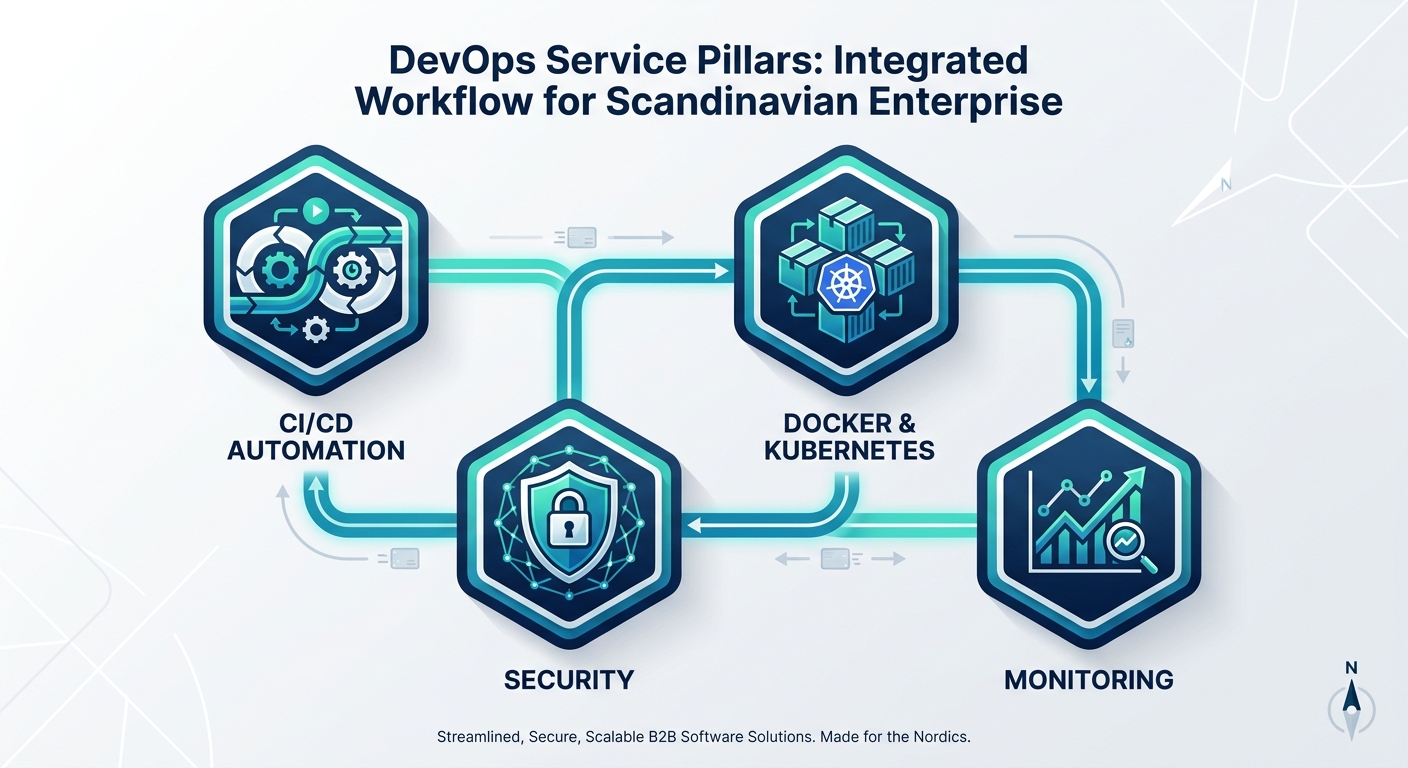
DevOps is not a single tool or service. It's a collection of practices and technologies that work together. Here are the core components that matter most for Swedish businesses in 2026.
Continuous Integration and Continuous Deployment (CI/CD) is the backbone of any DevOps operation. Every time a developer pushes code, an automated pipeline runs tests, checks for errors, builds the application, and deploys it to the appropriate environment. This eliminates manual deployment steps and dramatically reduces the risk of human error. For Swedish businesses, a well-configured CI/CD pipeline means you can release new features to customers in hours, not weeks.
Containers package your application and all its dependencies into a single, portable unit. Docker creates those containers. Kubernetes manages them at scale, automatically restarting failed containers, distributing traffic, and scaling up when demand increases. This combination is now the industry standard for running modern web applications reliably in Sweden and across Europe.
Tools like Terraform and Ansible let you define your entire cloud infrastructure in code files. This means your servers, databases, networking rules, and security configurations are version-controlled, repeatable, and auditable. For Swedish companies with GDPR obligations, IaC makes compliance documentation significantly easier.
You can't fix what you can't see. DevOps includes setting up tools like Prometheus, Grafana, Datadog, or New Relic to monitor application performance, track errors, and alert your team before small issues become outages. Swedish businesses operating 24/7 digital services need this layer of visibility.
Security is no longer an afterthought in modern DevOps. DevSecOps integrates security scanning, vulnerability checks, and compliance controls directly into the CI/CD pipeline. For Swedish companies handling personal data under GDPR, this approach ensures security is enforced at every stage of development and deployment.
Choosing the right cloud provider is one of the most important decisions in your DevOps Sweden strategy. Each major provider has strengths, and the right choice depends on your existing tools, team expertise, and compliance requirements.
AWS operates data centers in Stockholm (eu-north-1 region), making it a strong choice for Swedish businesses that need data residency within Sweden. AWS offers the broadest range of managed services, from EKS (Elastic Kubernetes Service) to RDS (managed databases) and Lambda (serverless functions). It's the most widely used cloud platform globally, which means extensive documentation, community support, and a large pool of engineers who know it well.
Azure is particularly popular among Swedish enterprises already using Microsoft products like Office 365 and Active Directory. Azure's Stockholm and Gävle data centers provide local data residency. Its integration with existing Microsoft tooling makes it a natural fit for larger Swedish organizations. Azure DevOps (formerly VSTS) is also a mature CI/CD platform that many Swedish development teams already use.
GCP is the home of Kubernetes (Google invented it), making it a strong choice for container-heavy workloads. Google's Stockholm region supports GDPR-compliant data storage. GCP tends to be favored by Swedish tech startups and data-intensive companies, particularly those using BigQuery for analytics or TensorFlow for machine learning.
Many Swedish enterprises use a combination of cloud providers to avoid vendor lock-in and optimize costs. A typical setup might use AWS for primary application hosting, Azure for identity management, and GCP for data analytics. DevOps tooling like Terraform makes managing multi-cloud environments practical. For guidance on how cloud choices affect your overall development approach, our complete guide to web development in Sweden 2026 covers the broader technology landscape.
Understanding how a CI/CD pipeline works helps you ask better questions when evaluating DevOps providers. Here's a practical breakdown of what happens when a developer pushes code in a well-configured DevOps Sweden environment.
Popular CI/CD tools used in Swedish DevOps environments include GitHub Actions, GitLab CI/CD, Jenkins, and CircleCI. The right choice depends on where your code is hosted and your team's existing workflow. For context on how development timelines and deployment processes affect your overall project budget, see our breakdown of how development timeline and duration impact budget.
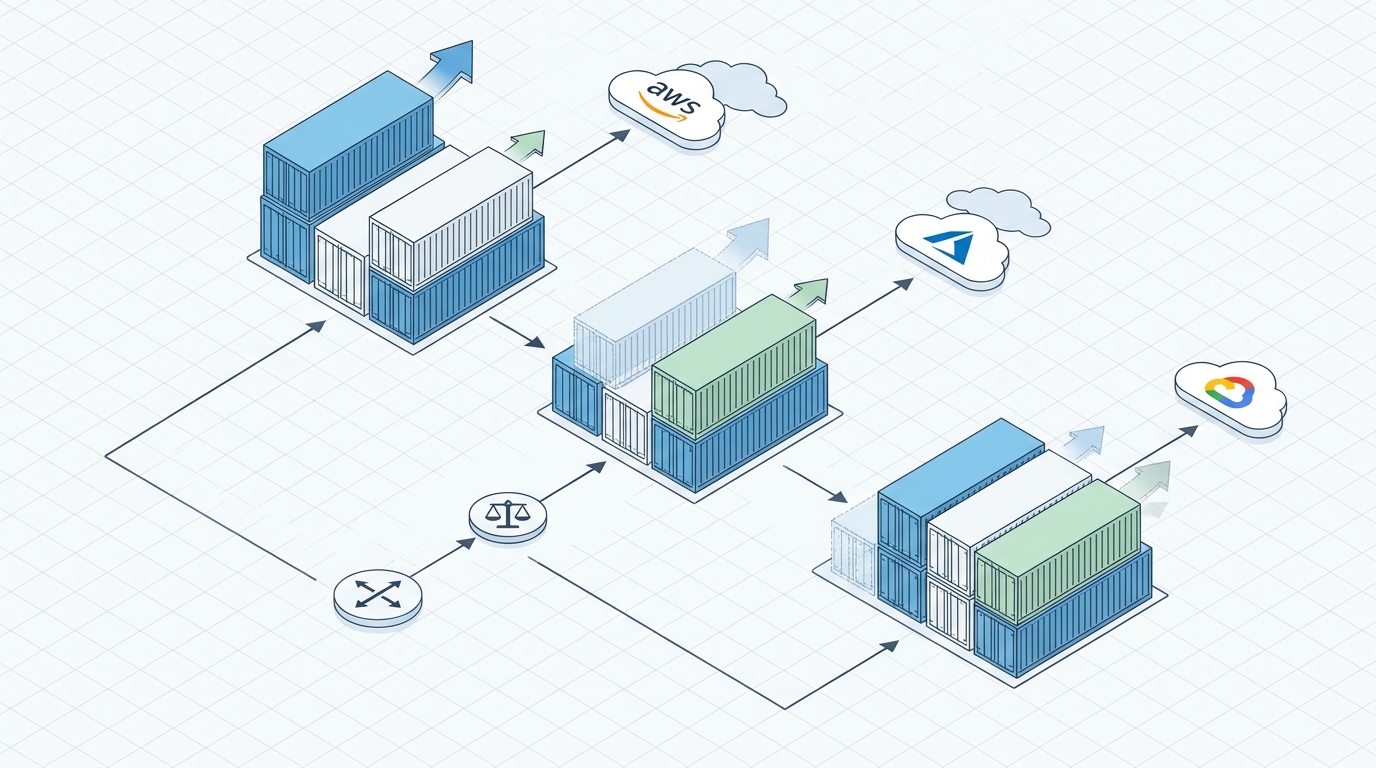
Containerization has become the foundation of modern DevOps, and for good reason. Containers solve one of the oldest problems in software: "it works on my machine." By packaging your application with all its dependencies, containers ensure consistent behavior across development, staging, and production environments.
Docker is the tool that creates and runs containers. For non-technical business owners, think of a Docker container like a shipping container: it holds everything your application needs to run, and it works the same way regardless of where it's deployed, whether that's a developer's laptop, a test server, or AWS in Stockholm. This consistency eliminates entire categories of deployment bugs.
Kubernetes (K8s) manages multiple containers across multiple servers. It handles automatic scaling (adding more containers when traffic increases), self-healing (restarting failed containers automatically), load balancing (distributing traffic evenly), and rolling updates (deploying new versions without downtime). For Swedish applications that need to handle variable traffic, such as e-commerce platforms during Swedish sales events or SaaS tools with European business-hours peaks, Kubernetes is essential infrastructure.
Running Kubernetes yourself is complex. All three major cloud providers offer managed Kubernetes services that handle the control plane for you:
For most Swedish startups and SMBs, a managed Kubernetes service is the right choice. It removes the operational burden of managing the Kubernetes control plane while giving you all the benefits of container orchestration. The cost implications of containerization are real but manageable, and the reliability gains typically justify the investment. For a broader view of how infrastructure decisions affect your app's total cost, our app development cost and budget guide 2026 provides useful context.

One of the most common questions Swedish businesses ask is: what does DevOps actually cost? The honest answer is that it depends on your application's complexity, your team's existing capabilities, and how much of the infrastructure you want managed for you. Here's a realistic framework for thinking about DevOps investment in Sweden in 2026.
Setting up a DevOps environment from scratch, including CI/CD pipelines, containerization, cloud infrastructure configuration, and monitoring, typically involves a one-time setup investment. This covers architecture design, tool configuration, security hardening, and documentation. The scope varies significantly based on application complexity and the number of environments (development, staging, production) required.
After setup, ongoing DevOps management includes cloud infrastructure costs (paid directly to AWS, Azure, or GCP), monitoring tool subscriptions, and engineering time for maintenance, updates, and incident response. Cloud costs for a typical Swedish SMB web application start at a few hundred euros per month and scale with usage. Managed DevOps retainer services from agencies provide predictable monthly costs for infrastructure oversight.
Swedish businesses have three main options for DevOps support:
The ROI of DevOps investment is well-documented. According to the DORA (DevOps Research and Assessment) annual reports, high-performing DevOps teams deploy code 973 times more frequently than low performers and recover from incidents 6,570 times faster. For Swedish businesses competing in fast-moving markets, that speed advantage translates directly into business outcomes.
For a realistic view of how infrastructure and maintenance costs fit into your overall digital budget, our guide on website maintenance costs in 2026 provides a useful breakdown.
Selecting a DevOps partner is a significant decision. Your infrastructure partner will have access to your production systems, your data, and your deployment processes. Here's how to evaluate candidates effectively.
DevOps is not a one-person job. It requires expertise across cloud architecture, security, networking, containerization, and monitoring. A freelancer might be strong in one or two areas but will have gaps in others. A full-service agency brings a team with complementary skills, documented processes, and the capacity to respond to incidents around the clock. For Swedish businesses running production applications, that reliability is worth the investment.
At Axire Infotech, our DevOps and cloud integration services are built specifically for European clients, including Swedish businesses navigating GDPR requirements, Nordic infrastructure preferences, and the need for fast, reliable application delivery. We combine development and operations expertise so your application is built to deploy from day one, not retrofitted for DevOps after the fact. View our project portfolio to see how we've helped businesses across Sweden, the UK, and the Netherlands build and deploy scalable digital products.
For guidance on evaluating any development or DevOps partner, our checklist of 12 questions to ask when evaluating a development partner is a practical starting point.
Yes, and the earlier you adopt DevOps practices, the better. Setting up a proper CI/CD pipeline and cloud infrastructure from the start is far less expensive than retrofitting it onto an existing application. Even a simple pipeline that automates testing and deployment saves significant time and prevents costly production errors. For startups building their first product, our guide on MVP development questions startups ask covers how DevOps fits into early-stage product development.
A basic CI/CD pipeline for a straightforward web application can be configured in a few days. A comprehensive DevOps environment with containerization, managed Kubernetes, monitoring, and security scanning for a complex application typically takes two to six weeks to set up properly. The timeline depends on your application's architecture, the number of environments needed, and how much existing infrastructure needs to be migrated.
Yes, when configured correctly. AWS, Azure, and Google Cloud all operate data centers in Sweden and offer GDPR-compliant configurations. The key is ensuring your DevOps setup enforces data residency (keeping data within EU/Swedish regions), encrypts data at rest and in transit, and implements proper access controls. A qualified DevOps partner will build these requirements into your infrastructure from the start, not as an afterthought.
DevOps practices are technology-agnostic. Whether your application is built with React and Node.js, Angular and .NET, or any other combination, CI/CD pipelines and containerization can be applied. The specific tools and configuration will vary, but the principles remain the same. If you're evaluating your current tech stack's suitability for modern DevOps, our guide on web development trends in 2026 covers the technologies that integrate most smoothly with DevOps workflows.
Cloud hosting is the infrastructure layer: servers, storage, and networking provided by AWS, Azure, or GCP. DevOps is the set of practices and tools that automate how you build, test, deploy, and monitor applications on that infrastructure. You can have cloud hosting without DevOps (manual deployments, no automation), but you can't have effective DevOps without cloud infrastructure. They work together: cloud provides the platform, DevOps provides the process.
DevOps applies to mobile app backends and APIs just as much as to web applications. Mobile apps typically connect to cloud-hosted APIs and services, and those backend systems benefit enormously from CI/CD automation, containerization, and monitoring. For Swedish businesses building mobile products, our complete guide to mobile app development in Sweden 2026 covers how backend DevOps practices support mobile application reliability.
The gap between building software and running it reliably in production is where many Swedish businesses lose time, money, and competitive ground. DevOps Sweden services close that gap by automating deployment, standardizing infrastructure, and giving your team the visibility to catch and fix problems before they affect customers. Whether you're a Stockholm startup launching your first product, an SMB scaling an e-commerce platform, or an enterprise modernizing legacy systems, the right DevOps foundation makes everything else faster and more reliable.
Axire Infotech works with Swedish businesses to design, build, and manage DevOps environments that match your application's needs and your team's capabilities. From CI/CD pipeline setup and Kubernetes configuration to ongoing cloud infrastructure management and security compliance, we handle the operational complexity so you can focus on building your product. Explore our full range of services to see how our development and DevOps capabilities work together, or contact our team today to discuss your specific infrastructure needs and get a clear picture of what a modern DevOps setup would look like for your Swedish business.
This blog post was written using thestacc.com
Let's discuss your project and create something amazing together.