Every failed development project has one thing in common: a poorly defined project scope. Whether you're a startup in Stockholm launching your first mobile app or an established business in the Netherlands rebuilding your e-commerce platform, the way you define your project scope before development begins will determine whether your project succeeds or spirals into costly overruns. In 2026, with development costs rising and competition intensifying across Sweden and Europe, getting your project scope right is not optional — it's the foundation of everything.
This guide walks you through the 9 essential elements every project scope document must include, the most common mistakes that derail development projects, and how to work with your development agency to build a scope that protects your budget, your timeline, and your business goals.
Scope creep is one of the leading causes of project failure in software development. According to the Project Management Institute, nearly 52% of projects experience scope creep, and those that do are significantly more likely to go over budget and miss deadlines. For businesses in Sweden and across Europe, where development investments often represent a significant portion of annual digital budgets, the stakes are especially high.
A well-defined project scope does several critical things. It aligns your development team and your business stakeholders on exactly what will be built. It creates a shared reference point for every decision made during the project. It protects you from paying for work you didn't ask for — and protects your agency from being asked to deliver work that was never agreed upon. Most importantly, it gives your project a realistic chance of being delivered on time and within budget.
Businesses across Sweden, the UK, and the Netherlands that invest time in proper scope definition consistently see better outcomes: fewer change requests, cleaner handoffs between project phases, and digital products that actually solve the business problem they were designed to address.
In the context of web and mobile app development, project scope is a formal document (or set of documents) that defines exactly what will be built, how it will function, who is responsible for what, and what success looks like. It covers features, deliverables, timelines, budgets, technical requirements, and the boundaries of the project — what is included and, just as importantly, what is not.
It's worth distinguishing between project scope and product scope. Product scope describes the features and functions of the final product. Project scope describes the work required to deliver that product, including design, development, testing, deployment, and documentation. Both need to be clearly defined before development begins.
Your project scope is also the backbone of your development proposal. Any agency worth working with will use your scope document to build their proposal, estimate costs, and plan resources. A vague scope leads to vague proposals, and vague proposals lead to misaligned expectations, disputes, and failed projects. For more on evaluating proposals, see our guide on how to evaluate a development partner.
The first and most critical element of any project scope document is a clear, prioritized list of features. This is where most projects go wrong. Business owners often describe what they want in broad terms ("I want an app like Airbnb") without specifying the individual features that make up that experience.
Start by listing every feature you believe the product needs. Then apply the MoSCoW prioritization method to sort them:
This prioritization exercise forces clarity. It also gives your development agency the information they need to build an accurate estimate. For e-commerce projects, for example, the difference between a basic product catalog and a full multi-currency, multi-language storefront is enormous in terms of both time and cost. Learn more about what goes into e-commerce development in Sweden and the features that matter most for European consumers.
A project scope without a timeline is incomplete. Your timeline should break the project into clear phases, with estimated durations for each. A typical web or mobile app development project moves through these phases:
Always build buffer time into your timeline, typically 15, 20% of the total estimated duration. Unexpected technical challenges, third-party API delays, and stakeholder feedback cycles are normal parts of development. Projects that don't account for buffer time almost always run late.
Timeline and budget are directly connected. Compressing a timeline often means adding developers, which increases cost. Extending a timeline can reduce cost but delays your time to market. Understanding this relationship is essential when defining your project scope. Our guide on how development timeline impacts budget explores this in detail.
Many businesses are reluctant to share their budget with a development agency, fearing the agency will simply charge up to that number. In reality, the opposite is true: sharing a realistic budget range helps your agency design a scope that fits your resources and prioritizes the features that deliver the most value.
Your project scope should include a budget range, not a fixed number. A range communicates your financial boundaries while giving the agency flexibility to propose the best solution within those constraints. When defining your budget, account for these often-overlooked costs:
For a detailed breakdown of what different types of projects cost, our app development cost guide provides feature-by-feature budget estimates that can help you set realistic expectations.
Deliverables are the tangible outputs your development agency will hand over at each stage of the project. A strong project scope document lists every deliverable with a clear description and acceptance criteria, the specific conditions that must be met for the deliverable to be considered complete.
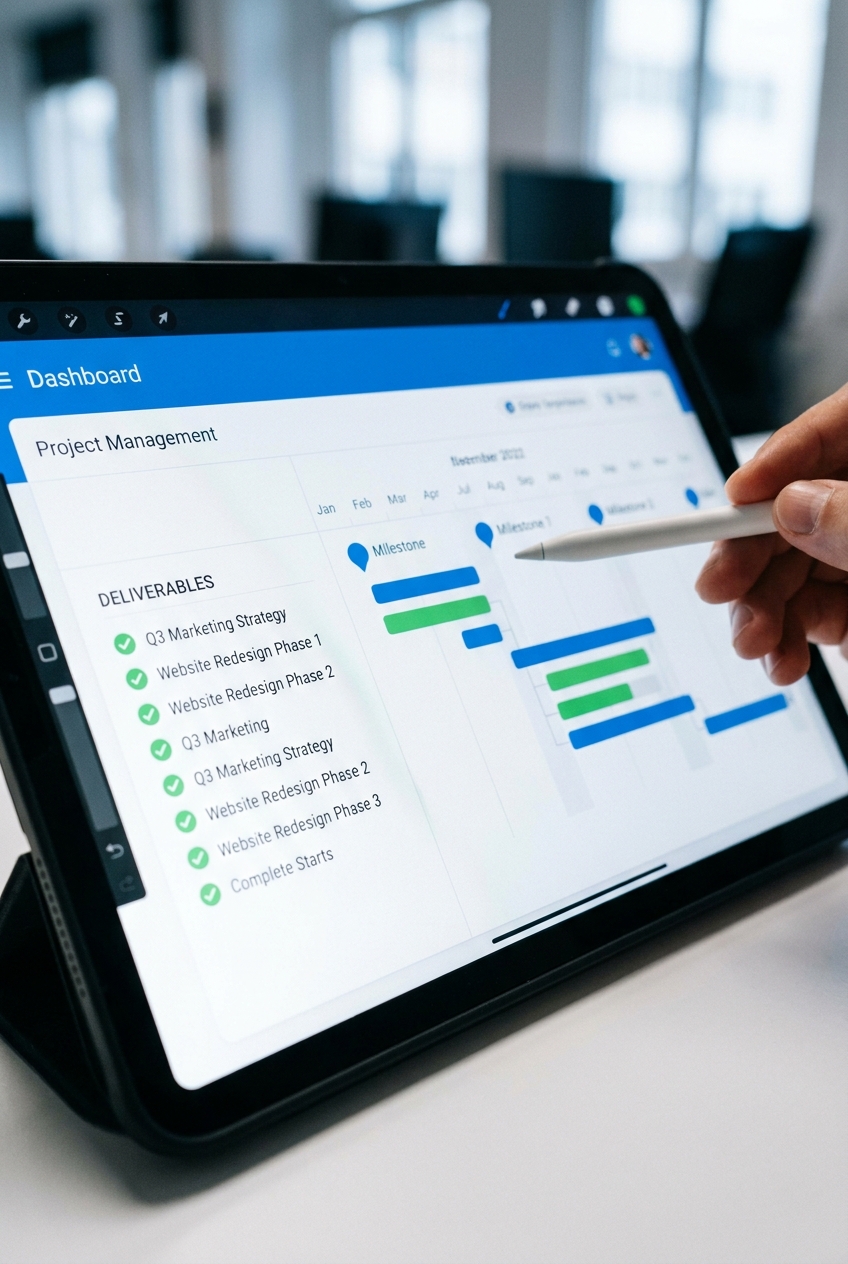
Common deliverables in a web or app development project include:
Acceptance criteria are what make deliverables enforceable. Instead of "the homepage should look good," write "the homepage must load in under 2 seconds on a 4G mobile connection, display correctly on Chrome, Firefox, Safari, and Edge, and match the approved design mockup within a 5% visual tolerance." Specific criteria eliminate ambiguity and protect both parties.
Documenting deliverables also helps you track project progress. When each phase has defined outputs, it's easy to see whether the project is on track, and to identify problems early before they compound.
Technical requirements define the technology stack, platform targets, performance benchmarks, and compliance standards your project must meet. This element of your project scope is especially important for businesses in Sweden and Europe, where GDPR compliance and accessibility standards (WCAG) are legal requirements, not optional extras.
Your technical requirements section should address:
For businesses in Sweden and the broader Nordic market, GDPR compliance is non-negotiable. Your scope document should explicitly state how user data will be collected, stored, and processed. Failing to address this at the scoping stage can result in costly rework later. Our WCAG compliance guide for Nordic markets covers the accessibility requirements that apply to your project.
One of the most overlooked elements of a project scope document is a clear stakeholder map. Who has the authority to approve designs? Who can request changes? Who is the single point of contact for the development agency? Without clear answers to these questions, projects stall in approval loops and suffer from conflicting feedback.
Your stakeholder section should define:
Also define your communication protocols. How often will you have status meetings? What tools will you use (Slack, email, project management software)? What is the expected response time for feedback? These details seem minor but have a significant impact on project velocity. Slow feedback cycles are one of the most common causes of timeline overruns in development projects.
A project scope that doesn't define what success looks like is incomplete. Success metrics give your development team a target to design and build toward. They also give you an objective way to evaluate whether the finished product has delivered on its promise.
Success metrics should be specific, measurable, and tied to your business goals. Examples include:
When your development agency understands your KPIs from the start, they make better design and architecture decisions. A team building for conversion will make different UI choices than a team building for engagement. Defining success metrics in your project scope ensures everyone is optimizing for the same outcomes.
Every project is built on a set of assumptions. The danger is when those assumptions are never written down. When an assumption turns out to be wrong, and it wasn't documented, both sides end up in a dispute about who is responsible for the resulting rework.
Your project scope should explicitly list all assumptions the project is based on. Common examples include:
Constraints are the boundaries within which the project must operate. These might include regulatory requirements (GDPR, PCI-DSS), existing technology systems that cannot be replaced, fixed launch dates tied to marketing campaigns, or budget ceilings that cannot be exceeded.
Documenting both assumptions and constraints creates a shared understanding of the project's operating conditions. If an assumption proves incorrect, the scope document provides a clear basis for discussing how the change affects timeline and budget, without blame or dispute.
No matter how thorough your project scope is, requirements will change. New business priorities emerge. User testing reveals unexpected usability issues. A competitor launches a feature you need to respond to. Change is inevitable in development projects. What matters is how you handle it.
A formal change management process, written into your scope document from the start, protects everyone. It should include:
Without a change management process, scope creep happens silently. Small requests accumulate, "can you just add a filter here?" or "can we change the color scheme?", and before long, the project is weeks behind schedule and significantly over budget. A formal process makes the cost of changes visible and keeps the project on track.

Even experienced businesses make critical mistakes when defining their project scope. Here are the most common ones, and how to avoid them.
"A user dashboard" is not a feature description. "A user dashboard that displays the last 10 orders, current subscription status, saved addresses, and a notification center with read/unread states" is a feature description. Vague descriptions lead to misaligned expectations and expensive rework. Every feature in your scope document should be described in enough detail that a developer who has never spoken to you could build it correctly.
Without acceptance criteria, there is no objective way to determine when a feature is "done." This creates endless revision cycles and disputes at the end of the project. Every deliverable needs clear, measurable criteria for completion.
Many businesses want to jump straight into design and development to save time. This almost always backfires. The discovery phase, where requirements are gathered, user research is conducted, and technical architecture is planned, is where the project scope is refined and validated. Skipping it means building on assumptions that may be fundamentally wrong. For startups especially, a proper discovery phase is essential. Our guide on MVP development for startups covers how to scope your first product effectively.
Third-party integrations, payment gateways, CRM systems, ERP platforms, shipping APIs, are consistently underestimated in project scopes. Each integration requires research, development, testing, and often ongoing maintenance. In the Swedish and European market, integrations with local payment systems like Klarna, Swish, or iDEAL add additional complexity that must be accounted for in the scope.
A project scope created entirely by the business side, without input from the development team, is almost always unrealistic. Developers and architects can identify technical constraints, suggest more efficient approaches, and flag potential problems before they become expensive. Involve your development agency in the scoping process from the beginning.
Your project scope should be a living document that is updated as the project evolves. Changes should be tracked, approved, and reflected in the scope. A scope document that is written once and never revisited quickly becomes irrelevant, and the project drifts away from it without anyone noticing.

The best project scope documents are built collaboratively, with both the client and the development agency contributing their expertise. Here's how to make that collaboration work.
A discovery workshop is a structured session (or series of sessions) where the client and the development team work together to define the project scope. It typically covers business goals, user personas, feature requirements, technical constraints, and success metrics. A good discovery workshop surfaces assumptions, identifies risks, and produces a shared understanding of what needs to be built and why.
At Axire Infotech, every project begins with a thorough discovery process. We work with clients across Sweden, the UK, and the Netherlands to understand their business context, their users, and their technical environment before a single line of code is written. This investment in upfront clarity consistently produces better outcomes, projects delivered on time, within budget, and built to scale.
When working with a development agency to define your project scope, come prepared with answers to these questions:
A development proposal that lacks a detailed project scope is a warning sign. If an agency gives you a fixed price quote without asking detailed questions about your requirements, they are either guessing or planning to charge for changes later. A credible agency will invest time in understanding your needs before committing to a price. Look for proposals that include a detailed feature list, phased timeline, clear deliverables, and explicit assumptions. For more guidance, see our analysis of what to look for in Swedish development agencies.
Businesses in Sweden and across Europe face specific requirements that must be reflected in the project scope. GDPR compliance affects how user data is collected, stored, and processed. WCAG 2.1 accessibility standards are increasingly enforced across the EU. Local payment methods (Klarna, Swish, iDEAL, Bancontact) require specific integrations. Language and localization requirements add complexity to content management systems. A development agency with experience in the European market will know to raise these issues during scoping, and will know how to address them efficiently.
Axire Infotech specializes in building digital products for European businesses. Our team has deep experience with the regulatory, cultural, and technical requirements of the Swedish, UK, and Dutch markets. View our project portfolio to see how we've helped businesses across Europe define and deliver successful development projects.
For a straightforward website or small web application, a basic project scope can be defined in 1, 2 weeks. For complex web applications, mobile apps, or enterprise platforms, a thorough scoping process typically takes 2, 4 weeks. This time is well spent, a week invested in scope definition can save months of rework later.
The project scope is a collaborative document. The client is responsible for defining business goals, feature priorities, budget, and success metrics. The development agency is responsible for translating those requirements into technical specifications, identifying constraints, and validating feasibility. Both parties should review and sign off on the final scope document before development begins.
Project scope defines the boundaries of the project, what is included and what is not. Requirements describe the specific behaviors and characteristics of the features within that scope. Requirements are typically more detailed and technical than scope statements. Both are necessary: scope prevents scope creep, while requirements ensure features are built correctly.
Yes, but changes should go through a formal change management process. Every change to the project scope should be documented, assessed for impact on timeline and budget, and approved by the project owner before implementation. Uncontrolled scope changes are the primary cause of budget overruns and missed deadlines in development projects.
Detailed enough that a developer who has never spoken to you could understand what needs to be built. For each feature, you should be able to describe the user interaction, the expected system behavior, and the acceptance criteria. For the overall project, you should be able to describe the deliverables, timeline, budget, technical requirements, and success metrics. If you can't describe it clearly, it's not ready to be built.
Yes. Even a simple 5-page marketing website benefits from a clear scope document. It doesn't need to be 50 pages, a well-structured 2, 3 page scope covering features, design requirements, technical specifications, timeline, and budget is sufficient for smaller projects. The discipline of writing it down forces clarity and prevents misunderstandings regardless of project size.
Defining a clear project scope is the single most important thing you can do before starting a web or mobile app development project. It protects your budget, keeps your timeline on track, and ensures the product you receive matches the product you envisioned. For businesses in Sweden and across Europe, where development investments are significant and market expectations are high, a well-defined project scope is the difference between a digital product that transforms your business and one that drains your resources.
The 9 elements covered in this guide, features and functionality, timeline, budget, deliverables, technical requirements, stakeholders, success metrics, assumptions and constraints, and change management, form the complete foundation of a successful development project. Use them as a checklist every time you start a new project, and you'll avoid the most common and costly mistakes in digital development.
Ready to define your project scope with a team that knows the European market? Axire Infotech works with startups, SMBs, and enterprises across Sweden, the UK, and the Netherlands to build digital products that deliver real business results. Contact our team today to start your discovery process, and build a project scope that sets your development project up for success from day one.
Explore our services: UI/UX Design | Web Development | App Development | View All Services
This blog post was written using thestacc.com
Let's discuss your project and create something amazing together.