If you're a business in Sweden looking to build a mobile app in 2026, you're entering one of Europe's most digitally advanced markets. Mobile app development in Sweden has matured significantly over the past few years, and the expectations from both businesses and end users are higher than ever. Whether you're a startup launching your first product or an established company expanding your digital presence, understanding what professional mobile app development involves will save you time, money, and frustration.
This guide covers everything you need to know: the full development process, realistic timelines, the right tech stack, how Swedish agencies operate, and how to choose a development partner that delivers real results. Let's get into it.

Sweden consistently ranks among the top countries in Europe for digital adoption. With smartphone penetration above 90% and a population that expects seamless digital experiences, the bar for mobile app development in Sweden is genuinely high. Swedish consumers are not forgiving of slow load times, confusing navigation, or apps that feel outdated.
Several industries are driving the current wave of mobile app investment across Sweden. Healthcare providers are building patient-facing apps for appointment booking and telemedicine. Retail and e-commerce brands are investing in mobile-first shopping experiences. Logistics companies need real-time tracking apps. And startups across fintech, proptech, and edtech are launching MVPs to validate their ideas quickly.
What makes the Swedish market distinct is its design sensibility. Scandinavian design principles, which emphasize clarity, function, and minimalism, directly influence how Swedish users interact with digital products. An app that looks cluttered or feels unintuitive will lose users fast. This is why UI/UX design is not an afterthought in Swedish mobile app projects. It's a core part of the process from day one.
For businesses outside Sweden working with Swedish clients or users, this context matters enormously. Building a mobile app for the Swedish market means understanding how European consumers interact with digital interfaces, what privacy standards they expect, and what level of polish they consider acceptable.
Professional mobile app development in Sweden follows a structured process. Skipping steps or rushing phases is one of the most common reasons projects fail or go over budget. Here's what a well-run project looks like from start to finish.
Before a single line of code is written, a good development partner will invest time in understanding your business goals, your target users, and the specific problems your app needs to solve. This phase typically involves stakeholder interviews, competitor analysis, and defining the core feature set. The output is a clear product brief and a prioritized feature list.
This is where your app starts to take visual shape. Designers create wireframes (low-fidelity layouts showing structure) and then high-fidelity prototypes (pixel-perfect designs showing exactly how the app will look and feel). User testing at this stage catches usability problems before development begins, which is far cheaper than fixing them later. Explore Axire Infotech's UI/UX design approach to see how design-first thinking shapes better mobile products.
Development is typically broken into sprints of one to two weeks. Each sprint delivers a working piece of functionality that can be reviewed and tested. This agile approach keeps the project on track and allows for adjustments based on real feedback rather than assumptions made at the start.
Quality assurance is not a single event at the end of a project. It runs throughout development. Testers check functionality, performance, security, and compatibility across different devices and operating system versions. For apps targeting Swedish users, GDPR compliance testing is also a critical part of this phase.
Submitting an app to the Apple App Store or Google Play Store involves specific technical and content requirements. A professional development team handles this process, including preparing store listings, screenshots, and compliance documentation.
Launching is not the finish line. User feedback, analytics data, and operating system updates all require ongoing attention. The best development partners offer structured post-launch support plans that keep your app performing well over time.
One of the first strategic decisions in any mobile app Sweden project is choosing your platform. This decision affects your budget, your timeline, and the experience your users will have.
Sweden has a relatively balanced split between iOS and Android users, with iOS holding a slight edge among urban professionals and higher-income demographics. Android has strong penetration across a broader demographic range. For most business apps targeting Swedish consumers, you need to support both platforms.
Building separate native apps for iOS (using Swift) and Android (using Kotlin) delivers the best possible performance and the most seamless integration with each platform's features. The trade-off is cost and time: you're essentially building two apps. This approach makes sense for apps where performance is critical, such as real-time tracking, augmented reality, or complex animations.
Frameworks like React Native and Flutter allow developers to write a single codebase that runs on both iOS and Android. This significantly reduces development time and cost while still delivering a high-quality user experience. For most business apps, MVPs, and startups, cross-platform is the practical and cost-effective choice. React Native, in particular, is widely used by React developers in Sweden and integrates well with web-based ecosystems.
If you're unsure which approach fits your project, the App Development Cost: Feature Complexity Budget Guide 2026 breaks down how platform choice affects your overall investment.

The technology choices behind your app determine how scalable, maintainable, and future-proof it will be. Here's what a modern mobile app development tech stack looks like for Swedish market projects in 2026.
React Native remains the dominant choice for cross-platform mobile development. It shares a component model with React (used in web development), which means teams with web development experience can contribute to mobile projects efficiently. Flutter, developed by Google, is gaining ground for projects that require highly custom UI or pixel-perfect animations.
Node.js is widely used for building the backend APIs that power mobile apps. It handles real-time data, user authentication, push notifications, and integrations with third-party services. For more complex data requirements, PostgreSQL or MongoDB are common database choices. Cloud infrastructure from AWS, Google Cloud, or Azure provides the scalability that growing Swedish businesses need.
Modern mobile apps are not just client-side products. They depend on reliable cloud infrastructure, automated deployment pipelines, and monitoring tools. DevOps practices ensure that updates can be deployed quickly and safely, and that performance issues are caught before they affect users. This is especially important for apps that handle sensitive user data, which is the norm in the Swedish market given GDPR requirements.
Most business apps in Sweden require integrations with payment gateways (Klarna, Stripe, Swish), analytics platforms, CRM systems, and communication tools. A well-architected app is built with these integrations in mind from the start, not bolted on as an afterthought.
Axire Infotech's development partner approach means we handle the full technical stack, from mobile frontend to cloud backend, so you don't need to coordinate multiple vendors. See how our mobile app development service is structured for businesses targeting European markets.
One of the most common questions from businesses exploring mobile app development in Sweden is: how long will this take? The honest answer depends on scope, but here are realistic benchmarks based on professional project delivery.
A minimum viable product focuses on the core features needed to validate your idea with real users. For a well-scoped MVP with a clear feature set, 8 to 16 weeks is a realistic timeline. This includes discovery, design, development, and testing. Rushing this phase to hit an arbitrary deadline is one of the most expensive mistakes a business can make.
A production-ready app with a complete feature set, multiple user roles, third-party integrations, and a polished UI typically takes between four and nine months. Complex apps with real-time features, advanced data processing, or custom hardware integrations can take longer.
Agile methodology, which most professional Swedish agencies use, breaks the project into two-week sprints with regular demos and reviews. This keeps the project visible and allows for course corrections without derailing the entire timeline.
Working with a development partner that understands the Swedish market means more than just technical competence. It means understanding the communication culture, the design expectations, and the regulatory environment that shapes how apps are built and used in Sweden.
Swedish business culture values directness, transparency, and flat hierarchies. Good development partners working with Swedish clients communicate proactively, flag issues early, and involve clients in decisions rather than presenting finished work for approval. Regular sprint reviews, shared project management tools, and clear documentation are standard practice.
Scandinavian design principles have a global reputation for good reason. In the context of mobile app development, this translates to a strong emphasis on usability, accessibility, and visual clarity. Agencies that serve the Swedish market invest heavily in the design phase because they know that Swedish users will notice and respond to quality design. Learn more about UI/UX design centered around how Europeans consume digital interfaces.
GDPR is not optional for apps operating in Sweden or anywhere in the EU. Professional development teams build data privacy into the architecture from the start. This includes proper consent management, data minimization practices, secure storage, and clear user controls over personal data. Apps that are not GDPR-compliant face significant legal and reputational risks.
Swedish businesses expect high quality, and professional agencies deliver it through rigorous testing processes. This includes automated unit tests, manual QA testing across devices, performance testing under load, and security audits. An app that crashes or performs poorly in production is not acceptable in the Swedish market.
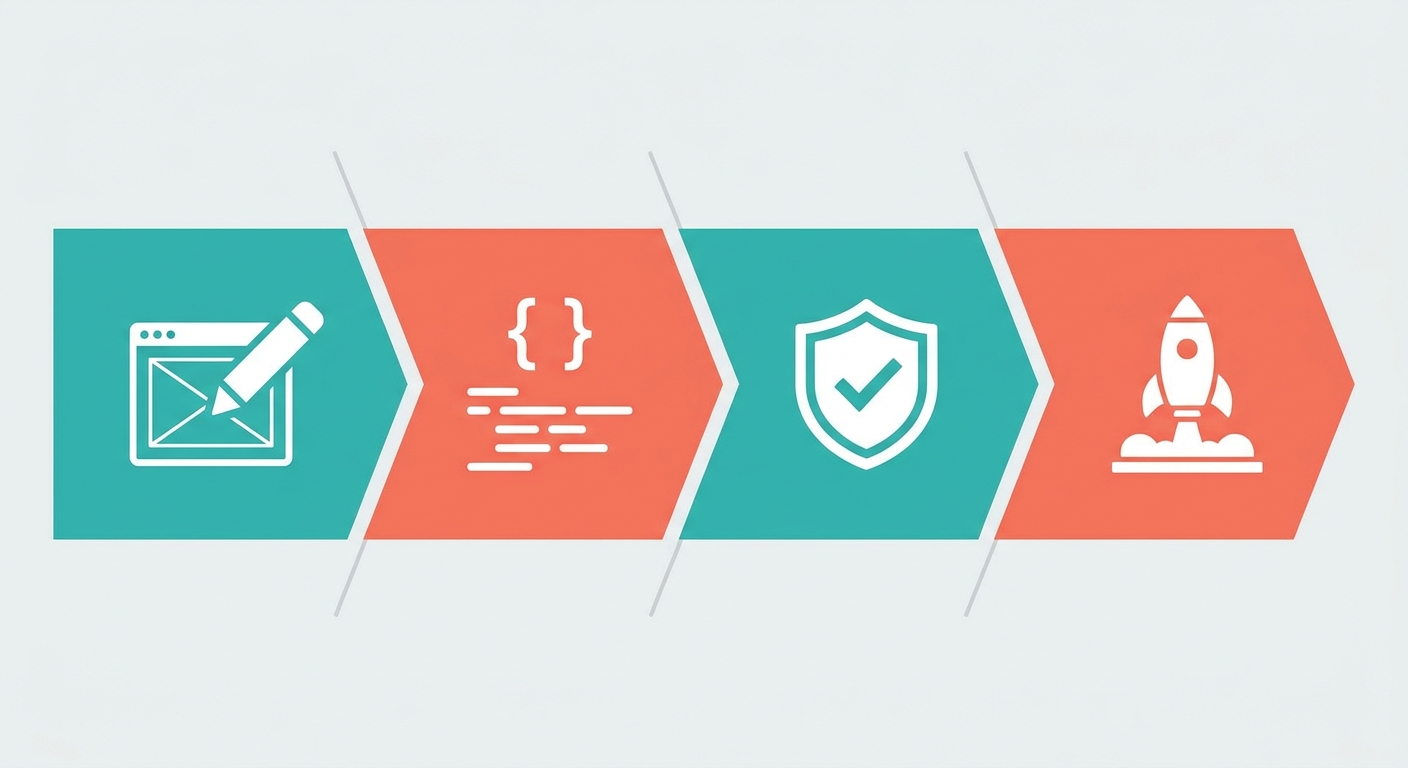
When you engage a professional agency for mobile app development in Sweden, you should expect a comprehensive service that covers the full project lifecycle. Here's what a well-structured engagement typically includes.
Dedicated sessions to understand your business goals, user needs, and technical requirements. This phase produces a product brief, feature prioritization, and a project roadmap. Skipping this step is a false economy: unclear requirements lead to expensive rework later.
User research, information architecture, wireframes, high-fidelity mockups, and interactive prototypes. You should receive design files that you own, along with a design system that ensures visual consistency across the app. For businesses also building or redesigning their website, this design work can inform the broader digital brand. See how web development in Sweden and mobile app development can be approached as a unified digital strategy.
Full development of the agreed feature set, with clean, documented code that you own outright. This is important: some agencies retain code ownership or use proprietary platforms that lock you in. A professional partner delivers code to a repository you control.
Functional testing, performance testing, security testing, and device compatibility testing. For apps targeting Swedish users, GDPR compliance verification is included. You should receive a test report before launch.
Preparation of App Store and Google Play listings, including screenshots, descriptions, and compliance documentation. The submission process has specific requirements that an experienced team handles efficiently.
Ongoing support for bug fixes, OS updates, performance monitoring, and feature iterations. The best development partners offer structured support plans rather than ad-hoc responses. This is where the long-term value of a good development partner relationship becomes clear.
To see the full range of services Axire Infotech provides for businesses across Sweden and Europe, view all our development and design services.

The agency or partner you choose will have more impact on your project's success than any other single factor. Here's how to evaluate your options for mobile app development in Sweden.
Platforms like Toptal connect businesses with individual freelancers, which can work for very specific, well-defined tasks. But for a complete mobile app project, a full-service agency provides something a freelancer marketplace cannot: a coordinated team with a project manager, designer, developers, and QA testers working together under a single point of accountability. When something goes wrong (and in complex projects, something always does), you want a team that owns the outcome, not a collection of individuals pointing at each other.
Axire Infotech serves businesses across Sweden, the United Kingdom, the Netherlands, and Finland with a full-service model that covers strategy, design, development, and ongoing support. Our teams are experienced in building for European markets, which means we understand the design expectations, regulatory requirements, and user behaviors that determine whether a mobile app succeeds or fails in Sweden.
App development costs vary widely based on complexity, platform choice, and the scope of features. A well-scoped MVP typically requires a different investment than a full-featured production app with complex integrations. For a detailed breakdown of how features and complexity affect cost, read our App Development Cost: Feature Complexity Budget Guide 2026. For a project-specific estimate, contact Axire Infotech directly.
An MVP typically takes 8 to 16 weeks. A full-featured app takes 4 to 9 months. Timeline depends heavily on scope clarity, design complexity, and the responsiveness of both the development team and the client during the project.
For most businesses, cross-platform development using React Native or Flutter is the right choice. It delivers a high-quality experience on both iOS and Android at a lower cost than building two separate native apps. Native development is worth the additional investment for apps with very high performance requirements or deep platform-specific integrations.
Post-launch, your app needs ongoing maintenance to stay compatible with new OS versions, address user-reported bugs, and iterate on features based on real usage data. A structured support plan from your development partner is the most efficient way to manage this. Axire Infotech offers post-launch support as part of our engagement model.
Absolutely. Many Swedish businesses work with development partners across Europe and beyond. What matters is the partner's understanding of the Swedish market, their communication practices, and their track record with similar projects. Axire Infotech works with clients across Sweden, the UK, the Netherlands, and Finland, with processes designed for effective remote collaboration.
Outsourcing development to a specialized agency means you get access to a full team of experts without the overhead of hiring in-house. For startups and SMBs in Sweden that need to move fast and manage costs, this is often the most practical path to a high-quality mobile app. The key is choosing a partner with a proven process and clear accountability.
Building a successful mobile app in Sweden requires more than good code. It requires a clear strategy, a design that meets Scandinavian quality standards, a modern tech stack, and a development partner who understands the European market. Whether you're launching an MVP to test a new idea or building a production-ready app for thousands of users, the process and the partner you choose will define your outcome.
Axire Infotech has helped businesses across Sweden, the UK, the Netherlands, and Finland build mobile apps that perform, convert, and scale. We bring together strategy, design, and engineering under one roof, so you have a single accountable partner from the first discovery session to post-launch support.
If you're ready to take the next step, get in touch with our team to discuss your project. We'll help you define the right scope, choose the right approach, and build a mobile app that delivers real results in the Swedish market. You can also explore more articles on our blog for deeper insights into web and mobile development for European businesses.
This blog post was written using thestacc.com
Let's discuss your project and create something amazing together.