Most businesses commissioning a digital project have heard the word "agile" dozens of times. They've seen it in agency proposals, read it in job descriptions, and nodded along in discovery calls. But when it comes to actually understanding what agile development means for their project, their budget, and their day-to-day involvement, the picture gets blurry fast.
This guide cuts through the jargon. Whether you're a startup founder in London preparing to build your first web app, an SMB in the Netherlands planning an e-commerce platform, or an enterprise team in Germany scoping a complex digital transformation, these 14 questions cover everything you need to know before signing a development contract.
The most common mistake businesses make isn't choosing the wrong technology or hiring the wrong agency. It's starting a project without understanding how the work will actually be managed. Development methodology determines how decisions get made, how changes are handled, and whether the final product reflects what you actually needed, or what you thought you needed six months ago.
Agile development has become the dominant methodology for web and mobile projects across the UK and Europe, and for good reason. But "agile" is also one of the most misused words in the industry. Some agencies claim to be agile while delivering projects in a way that's barely distinguishable from the rigid, plan-first approaches of the 1990s. Understanding the real process gives you the power to ask better questions, set better expectations, and get better results.
Here are the 14 questions businesses ask most often, answered plainly.
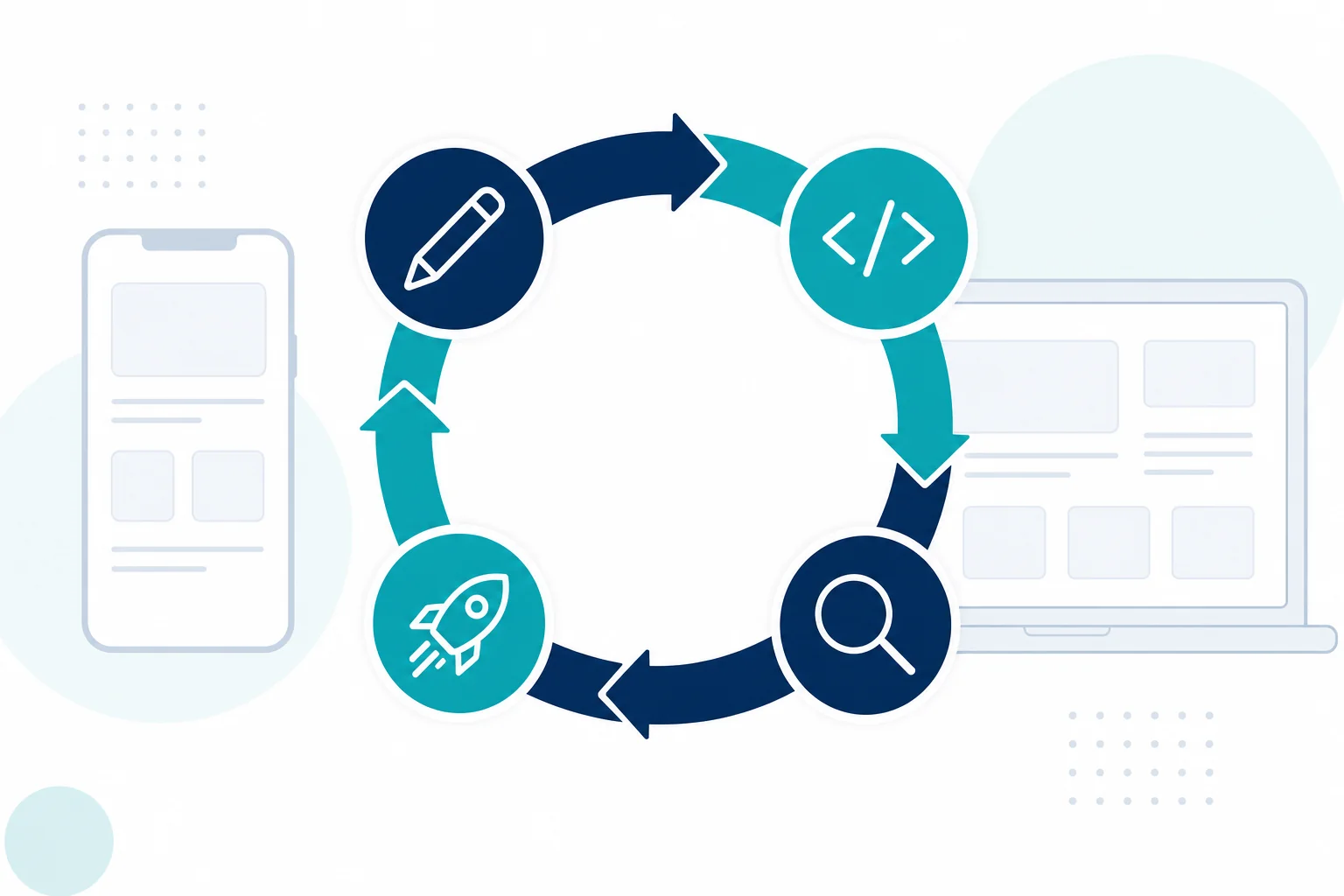
Agile development is an iterative approach to building software. Instead of planning every detail upfront and delivering a finished product at the end, agile teams work in short cycles, delivering working software incrementally and adjusting based on feedback along the way.
The methodology traces its roots to the Agile Manifesto, published in 2001 by a group of software practitioners who were frustrated with heavyweight, documentation-heavy processes. The manifesto established four core values:
These values don't mean documentation, contracts, or planning are unimportant. They mean that when trade-offs arise, agile teams prioritise people, working products, collaboration, and adaptability. For businesses building digital products in fast-moving markets, that priority order makes a significant difference.
Waterfall is the traditional alternative to agile. It works in sequential phases: requirements are gathered, then design is completed, then development begins, then testing happens, and finally the product is deployed. Each phase must be finished before the next begins.
The problem with waterfall for most digital projects is that requirements change. A feature that seemed essential in month one may be irrelevant by month six. A design that looked great on paper may perform poorly with real users. In waterfall, discovering these issues late is expensive because you're reworking completed phases.
Agile addresses this directly. Here's how the two approaches compare:
Waterfall still has its place, particularly for projects with fixed, well-understood requirements and strict regulatory constraints. But for the vast majority of web and mobile projects, agile delivers better outcomes. For more on how project structure affects your budget, see our guide on how development timeline impacts cost.
A sprint is the fundamental unit of work in agile development. It's a fixed-length period, typically one to four weeks, during which the team commits to completing a defined set of tasks from the project backlog.
Each sprint follows a consistent rhythm:
The result is a predictable delivery rhythm. At the end of every sprint, you have something tangible to review, test, and respond to. This is fundamentally different from waiting months for a "big reveal" that may or may not match your expectations.
Agile is an umbrella term. Several specific frameworks implement agile principles in different ways. The three most relevant for business clients are:
Scrum is the most widely used agile framework for software development. It defines three key roles: the Product Owner (typically the client or their representative, responsible for priorities), the Scrum Master (who facilitates the process and removes blockers), and the Development Team (who build the product). Scrum uses fixed-length sprints and a structured set of ceremonies. It works well for most web and mobile app projects.
Kanban focuses on continuous flow rather than fixed sprints. Work items move through stages on a visual board (To Do, In Progress, Done), with limits on how many items can be in progress at once. Kanban suits ongoing maintenance work, support teams, and projects where priorities shift frequently without a fixed release cadence.
SAFe is designed for large enterprises running multiple agile teams simultaneously. It adds coordination layers above the team level to align work across departments and programmes. For most startups and SMBs, SAFe is unnecessary overhead. It becomes relevant when you're coordinating five or more development teams on interconnected products.
Web and mobile projects are uniquely suited to agile because their requirements are inherently uncertain. User behaviour is unpredictable. Market conditions shift. Competitor products launch and change what users expect. A methodology that assumes you can define everything upfront is poorly matched to this reality.
Here's why agile works particularly well for digital product development:
For businesses across the UK, Ireland, and the Netherlands building customer-facing digital products, the ability to respond to real-world feedback before the full budget is spent is one of agile's most tangible advantages.
This is one of the most important questions to answer honestly before starting an agile project. Agile requires more ongoing client involvement than waterfall, but it's structured involvement, not open-ended availability.
In a typical Scrum engagement, a client acting as Product Owner should expect to commit:
In total, most clients spend three to five hours per week on agile project involvement. That's a meaningful commitment, but it's also what separates projects that deliver exactly what the business needs from those that drift away from the original vision.
The key insight is this: the more clearly and promptly you communicate your priorities and feedback, the faster and more accurately the team can build. Delayed feedback is one of the most common causes of sprint blockers and wasted development time.
Risk in software development comes in several forms: technical risk (will this actually work?), product risk (will users want this?), and budget risk (will we run out of money before we're done?). Agile addresses all three more effectively than waterfall.
By building and testing incrementally, technical problems surface within weeks rather than months. A complex integration that would have been discovered at the end of a waterfall project gets identified in sprint two, when it's still cheap to address.
Agile's sprint reviews create regular checkpoints where the client can verify that what's being built matches what was intended. If the product is drifting in the wrong direction, course corrections happen in the next sprint, not after the entire budget has been spent.
Because work is prioritised by business value, the most important features are built first. If budget constraints require the project to stop early, you have a working product with the core functionality intact, rather than a half-finished system with no usable components. For a deeper look at managing development budgets, our development budget planning guide covers this in detail.
Yes, but it requires a clear understanding of how scope and budget interact. There are two common contract structures for agile projects:
The client pays for the actual time and resources used each sprint. This gives maximum flexibility but requires trust and strong budget monitoring. T&M works well when requirements are genuinely uncertain and the client wants to retain full control over priorities.
A defined scope is agreed upfront (typically for an MVP or a specific phase), and the agency delivers that scope within a fixed budget using agile methods internally. This gives the client budget certainty while still benefiting from agile's iterative approach within the agreed scope.
The most important factor in making agile work within a fixed budget is a well-prioritised backlog. If you know which features are essential and which are desirable, the team can protect the core deliverables even if scope adjustments become necessary. Our guide on how to define project scope is a useful starting point for this exercise.
Speed to market is one of the most cited reasons European startups and SMBs choose agile. The mechanism is straightforward: instead of waiting for a complete product, you ship a working version with core functionality and iterate from there.
Several factors contribute to agile's speed advantage:
For startups across the UK and Europe competing in fast-moving markets, the ability to launch a working product in eight to twelve weeks rather than six to nine months can be the difference between capturing a market opportunity and missing it entirely.
This is where agile genuinely shines compared to waterfall. In a waterfall project, a change request mid-development typically triggers a formal change control process, a revised timeline, and additional costs. In agile, change is expected and accommodated through the product backlog.
The product backlog is a prioritised list of all features, improvements, and fixes for the product. It's a living document, updated continuously as new information emerges. When a requirement changes, the Product Owner simply updates the backlog: new items are added, priorities are adjusted, and the change is incorporated into the next sprint planning session.
This doesn't mean changes are free. Adding significant new features still requires time and budget. But the process for handling change is built into agile from the start, rather than being an exception that disrupts the entire project plan.
The practical implication for clients: you don't need to have every requirement perfectly defined before starting. You need a clear vision of the core product and a willingness to engage regularly as the details evolve.
Agile and DevOps are complementary practices that work best together. Agile governs how the team plans and delivers work. DevOps governs how that work gets deployed and maintained in production.
Continuous Integration (CI) means that code written by developers is automatically tested and merged into the main codebase multiple times per day. This prevents the "integration hell" that occurs when multiple developers' work is combined for the first time at the end of a project.
Continuous Delivery (CD) means that tested, integrated code can be deployed to production at any time with minimal manual intervention. In an agile context, this means the working software delivered at the end of each sprint can be released to real users quickly and reliably.
Together, CI/CD pipelines dramatically increase sprint velocity and reduce the risk of deployment failures. For businesses building cloud-native applications, this integration is particularly valuable. Our DevOps and cloud deployment guide covers the infrastructure side of this in detail.
Agile is exceptionally well-suited to both e-commerce and SaaS development, for different but complementary reasons.
E-commerce platforms have a core set of non-negotiable features (product catalogue, cart, checkout, payment processing) and a long tail of enhancements (personalisation, loyalty programmes, advanced search, A/B testing). Agile allows you to launch with the core functionality and add enhancements based on actual sales data and customer behaviour. For European retailers, this also means you can adapt quickly to seasonal demand patterns and regional payment preferences without waiting for a full platform rebuild.
SaaS products are never truly "finished." They evolve continuously based on user feedback, competitive pressure, and new market opportunities. Agile's iterative model is a natural fit: each sprint delivers new features or improvements, and the product roadmap is continuously refined based on usage data and customer input. For B2B SaaS teams across the UK and Europe, this means faster feature releases and a tighter feedback loop with enterprise customers.
For businesses evaluating progressive web app development as part of their digital strategy, our PWA development guide explores how agile delivery applies to this specific technology.
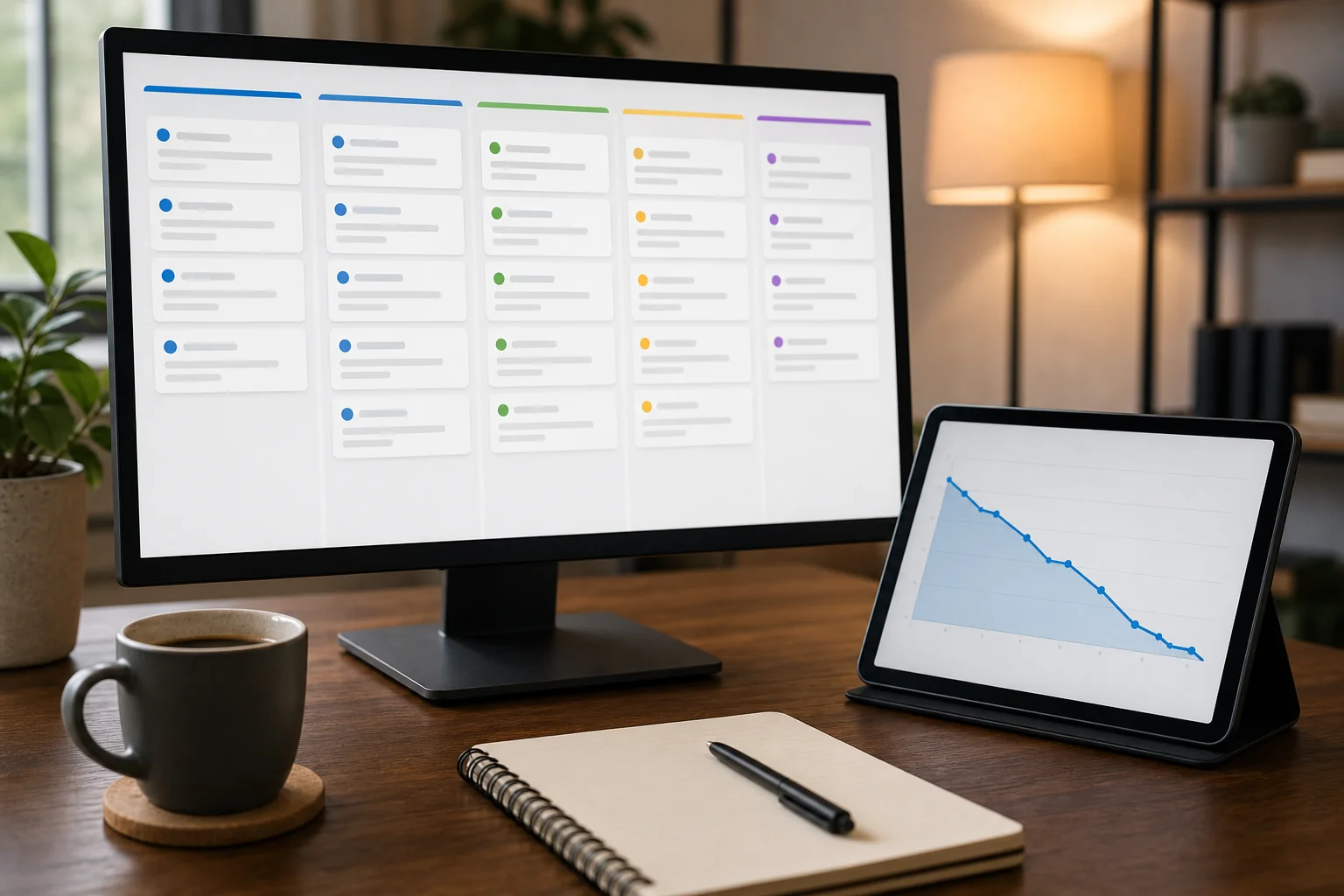
One of the most common concerns business clients have about agile is visibility. Without a traditional project plan with milestones and Gantt charts, how do you know if the project is on track?
Agile uses several tools and metrics to provide clear, honest progress visibility:
Velocity measures how much work a team completes per sprint, expressed in story points (a relative measure of effort). Over time, a consistent velocity allows accurate forecasting of how much work can be completed in future sprints. If velocity drops, it's an early warning signal that something needs attention.
A burndown chart shows the amount of remaining work in a sprint or release plotted against time. A healthy burndown chart shows a steady decline toward zero by the end of the sprint. Deviations from the expected line indicate scope creep, underestimation, or blockers that need addressing.
The Definition of Done is a shared agreement between the team and client about what "complete" means for any given task. It typically includes criteria like: code reviewed, unit tests passing, integrated with staging environment, and accepted by the Product Owner. This prevents the common problem of work being marked "done" when it's actually only partially complete.
Most agile teams use tools like Jira, Trello, or Linear to manage their backlog and sprint boards. These tools give clients real-time visibility into what's in progress, what's completed, and what's coming next, without requiring a formal status report from the project manager.

The gap between agencies that claim to be agile and those that genuinely practise it is wider than most clients realise. Here are the questions to ask and the signals to watch for.
For a broader view of what to look for when evaluating development partners, our post on 7 red flags when choosing a development agency covers the warning signs that apply regardless of methodology.
At Axire Infotech, agile development is the foundation of every web, mobile, and e-commerce project we deliver for clients across the UK, Netherlands, Ireland, Belgium, and the wider European market. Our process includes structured sprint planning, regular client-facing sprint reviews, transparent backlog management, and CI/CD pipelines that allow working software to be deployed and tested continuously throughout the project.
We work with startups building their first MVP, SMBs upgrading legacy platforms, and enterprises scoping complex digital transformations. In each case, the agile framework is adapted to the client's level of technical involvement and the project's specific requirements, not applied as a one-size-fits-all template.
You can explore our web development services, mobile app development services, and UI/UX design services to understand how agile principles shape each discipline. Or view our project portfolio to see the outcomes this approach delivers in practice.
Agile development isn't a buzzword. It's a proven methodology that reduces risk, accelerates delivery, and keeps your project aligned with real business needs as they evolve. For businesses across the UK and Europe, it's the most reliable way to build digital products that actually work in the market, not just in the specification document.
The 14 questions above cover the fundamentals, but every project has its own context. The right sprint length, the right contract structure, the right level of client involvement, and the right agile framework all depend on your specific goals, team, and timeline.
If you're planning a web application, mobile app, or e-commerce platform and want to understand how agile development would work for your specific project, the best next step is a direct conversation. Contact the Axire Infotech team to discuss your project requirements, and we'll walk you through exactly how we'd approach it, sprint by sprint.
You can also explore our full range of services at axireinfotech.com/services, or browse our latest articles for more guides on development methodology, technology selection, and digital strategy for European businesses.
Let's discuss your project and create something amazing together.