Most furniture brands that struggle online aren't struggling because of their products. They're struggling because their platform was never designed for the way people actually buy furniture. A customer browsing a sofa doesn't behave like someone buying a phone case. They spend weeks researching. They want to see the fabric up close, understand the exact dimensions, know whether it fits through a narrow hallway, and feel confident that delivery won't be a nightmare. Generic e-commerce platforms weren't built for that journey — and European direct-to-consumer furniture brands are paying the price.
This guide is for furniture retailers across the UK, Netherlands, Sweden, Germany, Belgium, and beyond who are ready to build or upgrade their online store. We'll cover what a purpose-built e-commerce platform for furniture retailers actually needs, how to choose the right architecture, what integrations matter, and how to find a development partner who understands the European market.
Furniture is a high-consideration purchase. The average European consumer visits a furniture website multiple times before buying, often over a period of several weeks. They compare materials, read reviews, check return policies, and frequently abandon their cart — not because they've lost interest, but because something on the page didn't give them enough confidence to commit.
This behaviour creates a very specific set of requirements that most off-the-shelf platforms simply don't address well. Platforms like Shopify or WooCommerce are excellent for straightforward retail. But furniture introduces complexity at almost every layer of the buying journey:
European DTC furniture brands face an additional layer of complexity: they're often selling across multiple countries with different languages, currencies, payment preferences, and consumer protection regulations. A platform that works well for a single-market UK retailer may buckle under the weight of cross-border European operations.
The gap between what generic platforms offer and what furniture retailers actually need is where most digital investments go wrong. Brands either over-invest in customising a platform that was never designed for their use case, or they under-invest and launch a store that looks fine but converts poorly.
Before choosing a platform or a development partner, it's worth being precise about the features that genuinely move the needle for furniture e-commerce. Not every feature on this list is essential for every brand, but understanding the full picture helps you prioritise your build correctly.
Furniture shoppers want to see the product in context. Static photography is no longer enough. The most effective furniture e-commerce platforms in 2026 include 360-degree product views, room visualisers that let customers place furniture in a photo of their own space, and augmented reality (AR) tools for mobile users. These features directly reduce return rates and increase conversion on high-value items.
A sofa might come in 12 fabric options, 4 leg finishes, 3 sizes, and 2 configurations. Standard e-commerce variant systems weren't built for this. A furniture platform needs a product configurator that handles conditional logic (some fabrics only available in certain sizes), real-time price updates as options are selected, and accurate lead time calculations for made-to-order items.
White-glove delivery is a major differentiator for premium furniture brands. Your platform needs to integrate with logistics providers to offer delivery slot selection at checkout, real-time tracking, and clear communication about assembly services. This is one of the most common gaps in furniture e-commerce builds — and one of the most impactful for customer satisfaction.
European consumers increasingly expect flexible payment options for high-value purchases. Klarna is dominant in Sweden and the UK. iDEAL is essential in the Netherlands. Bancontact is the default in Belgium. A furniture e-commerce platform that doesn't support the right payment methods for each market will lose sales at the final step of a long buying journey.
For brands selling across Europe, localisation goes beyond translation. Prices need to display in local currencies with accurate tax calculations. Product descriptions need to reflect local terminology. Customer service touchpoints need to match local expectations. This requires a platform architecture that supports true localisation, not just a language switcher bolted onto a single-market store.
One of the most consequential decisions a furniture retailer makes is choosing the right platform architecture. There's no single right answer, the best choice depends on your catalogue complexity, your growth ambitions, your budget, and your technical team's capacity.
SaaS platforms are fast to launch and relatively affordable to maintain. For furniture brands with straightforward catalogues and single-market operations, they can work well. But they hit their limits quickly when you need advanced product configuration, complex delivery integrations, or deep localisation for multiple European markets. The cost of customising a SaaS platform to handle furniture-specific requirements often exceeds the cost of a purpose-built solution, and you're still constrained by the platform's underlying architecture.
Headless commerce decouples the frontend (what customers see) from the backend (commerce logic, inventory, orders). This gives development teams the freedom to build exactly the user experience a furniture brand needs, without being constrained by a platform's default templates or component library. The backend handles commerce operations reliably, while the frontend is built with modern frameworks like Next.js or React for performance, flexibility, and SEO.
For European furniture brands targeting multiple markets, headless architecture is increasingly the standard. It allows you to serve different storefronts for different countries from a single backend, with localised content, pricing, and payment methods for each. You can explore how Next.js compares to React for this kind of build in our guide on Custom Software Development in Sweden: The 2026 Ultimate Guide.
Some furniture brands, particularly those with highly complex made-to-order catalogues, proprietary logistics networks, or enterprise-scale operations, need a fully custom platform. This is a significant investment, but it delivers complete control over every aspect of the buying experience. The decision to go fully custom should be driven by specific business requirements that no existing platform can meet, not by a general preference for bespoke solutions.
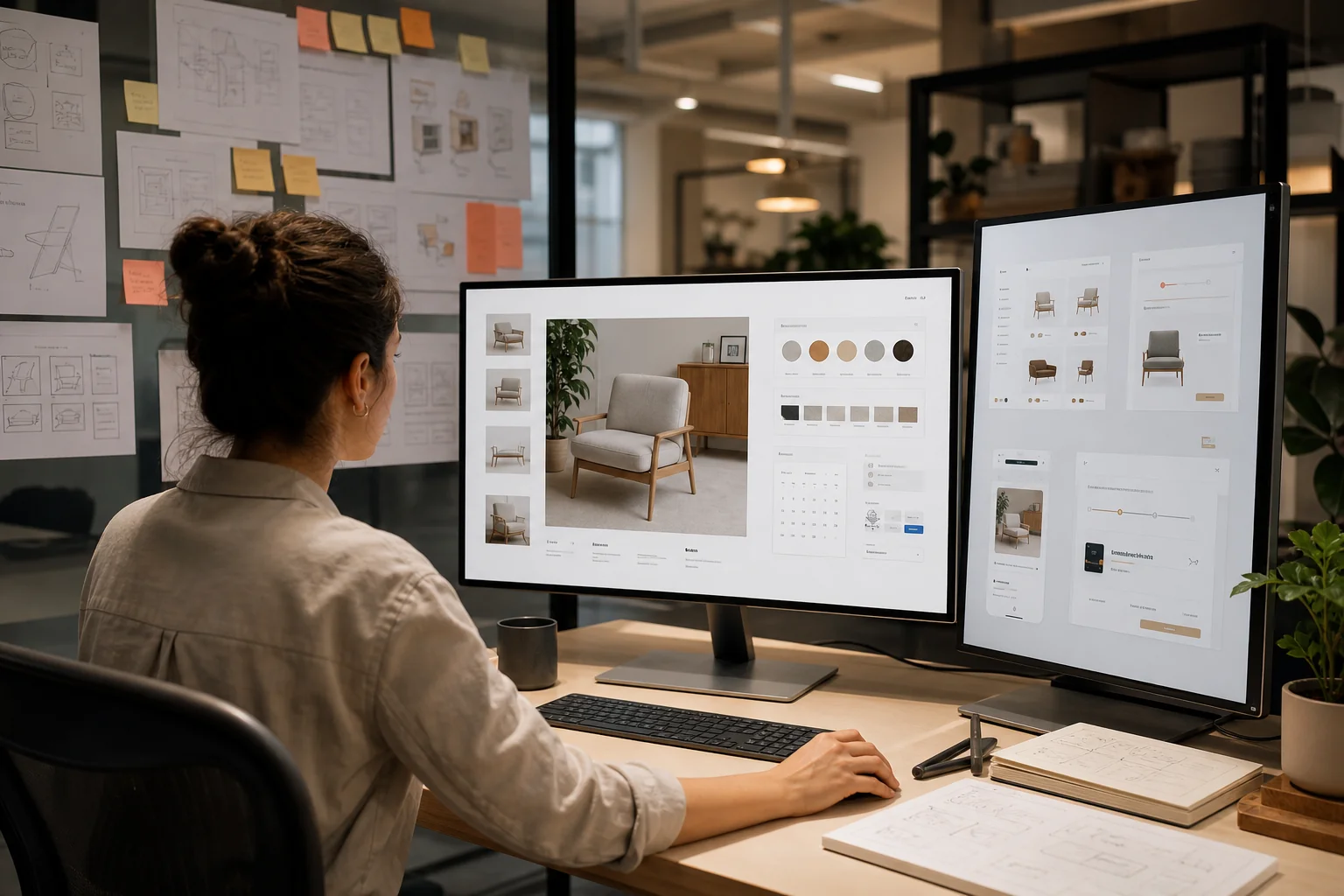
The best platform architecture in the world won't save a furniture store with poor UX. European consumers are sophisticated digital shoppers, they have high expectations for interface quality, and they're quick to abandon a site that feels slow, cluttered, or untrustworthy. Understanding how they browse and buy is essential to designing a store that converts.
A furniture product page needs to answer every question a customer would ask in a physical showroom. That means high-resolution imagery from multiple angles, accurate colour representation, detailed dimension diagrams, material descriptions, care instructions, and clear delivery and returns information. The page should also surface social proof, reviews, ratings, and user-generated photos, in a way that feels natural rather than forced.
Dimension visualisation is particularly important. European apartments and homes vary significantly in size, and customers in Amsterdam, Stockholm, or London are acutely aware of space constraints. A dimension guide that shows the sofa in a room context, with measurements clearly labelled, reduces the anxiety that drives cart abandonment.
More than 60% of furniture e-commerce traffic in Europe now comes from mobile devices, but conversion rates on mobile remain significantly lower than desktop. The gap isn't because people don't want to buy on mobile. It's because most furniture stores weren't designed for it. Mobile-first design for furniture means rethinking how product configurators work on small screens, how imagery loads efficiently without sacrificing quality, and how checkout flows are simplified for touch interfaces.
For brands targeting Swedish, Dutch, or UK consumers, mobile performance is non-negotiable. These are markets with high smartphone penetration and low tolerance for slow-loading pages. Our work on PWA Development Sweden explores how progressive web app architecture can dramatically improve mobile performance for e-commerce brands in these markets.
European consumers are cautious with high-value online purchases. Trust signals need to be woven throughout the buying journey, not just placed on a checkout page. This includes clear return policies (particularly important in markets where consumer protection regulations are strong), secure payment badges, delivery guarantees, and visible customer service contact options. In Germany and the Netherlands especially, the absence of a clear returns policy is one of the most common reasons for cart abandonment.
A €1,200 sofa purchase requires a different checkout experience than a €30 t-shirt. Customers need reassurance at every step. Progress indicators, order summaries with product images, clear delivery date confirmation, and multiple payment options all reduce the anxiety that causes last-minute abandonment. For brands offering financing, the BNPL option should be surfaced early in the buying journey, not just at checkout, so customers can plan their purchase with confidence.
Axire Infotech's UI/UX design practice is built around how European consumers interact with digital interfaces. Explore our UI/UX design services to see how we approach conversion-focused design for e-commerce brands.

A furniture e-commerce platform is only as strong as its integrations. The buying experience customers see is the tip of the iceberg, beneath it is a network of connected systems that need to work together seamlessly. Getting these integrations right is often where the real complexity of a furniture e-commerce build lives.
A Product Information Management (PIM) system is essential for furniture brands with large, complex catalogues. A PIM centralises all product data, descriptions, dimensions, materials, images, variants, and feeds it consistently to your e-commerce platform, your marketing channels, and any wholesale or marketplace integrations. Without a PIM, managing a catalogue of hundreds of SKUs with dozens of variants each becomes a manual, error-prone process that slows down your team and introduces inconsistencies that damage customer trust.
Your e-commerce platform needs to talk to your ERP system in real time. When a customer places an order, your inventory needs to update immediately. When a product goes out of stock, your website needs to reflect that before another customer completes a purchase. ERP integration also enables accurate lead time calculations for made-to-order items, a critical feature for furniture brands where production timelines vary by product and configuration. For a deeper look at how API-driven integrations work in practice, our API Integration FAQ covers the most common questions businesses ask.
Payment localisation is not optional for European furniture brands. The right payment mix depends on your target markets:
White-glove delivery is a competitive differentiator for premium furniture brands. Integrating with logistics providers via API allows you to offer real-time delivery slot selection, automated booking confirmation, live tracking, and proactive communication when delays occur. This integration is complex to build but has a direct impact on customer satisfaction and repeat purchase rates.
Furniture has a long repurchase cycle, but customers who buy once are valuable long-term prospects. A CRM integration allows you to segment customers by purchase history, trigger post-purchase sequences (assembly guides, care tips, accessory recommendations), and build loyalty programmes that bring customers back when they're ready to furnish another room.
Development costs for furniture e-commerce vary significantly depending on the platform architecture, the complexity of your catalogue, and the integrations you need. Here's a realistic framework for budgeting in 2026.
A Shopify or BigCommerce store with custom theme development and basic furniture-specific features (enhanced product pages, delivery integration, localisation for 2-3 markets) typically ranges from €15,000 to €45,000 in development costs. This is the fastest route to market but comes with ongoing platform fees and the limitations discussed earlier. Maintenance and ongoing development costs are a significant consideration, our Website Maintenance Costs in 2026 guide provides a detailed breakdown of what to expect after launch.
A headless architecture with a Next.js frontend, a commerce backend (Shopify Plus, Commercetools, or similar), and integrations for PIM, ERP, and localised payments typically ranges from €60,000 to €150,000+ depending on scope. This investment is justified for brands targeting multiple European markets, managing complex catalogues, or requiring advanced product configuration features. The performance and flexibility gains are substantial, and the platform scales with your business without requiring a rebuild.
Fully custom builds for enterprise furniture brands with proprietary logistics, complex made-to-order workflows, or multi-brand operations start at €150,000 and can reach significantly higher depending on scope. These projects require careful scoping and phased delivery to manage budget and risk. Our guide on Development Timeline and Cost explains how project duration directly affects your total investment.
Most furniture brands don't need to build everything at once. A phased approach, launching with core commerce functionality and adding AR visualisation, advanced configuration, and additional market localisation in subsequent phases, allows you to generate revenue from your platform while continuing to invest in it. This approach also reduces risk: you learn what your customers actually need before committing to expensive features.

The agency you choose will shape the outcome of your platform build more than any other single decision. For furniture e-commerce specifically, you need a partner who understands both the technical complexity of the build and the commercial context of European retail.
Look for agencies with demonstrable experience building e-commerce platforms for high-consideration product categories. Furniture shares characteristics with other complex retail categories, automotive accessories, luxury goods, bespoke products, so experience in adjacent categories is relevant. More important than sector-specific experience is evidence that the agency understands European consumer behaviour, localisation requirements, and the payment and logistics landscape across your target markets.
Technical capability matters too. A furniture e-commerce build in 2026 requires expertise in modern frontend frameworks (Next.js, React), API-first architecture, headless commerce platforms, and cloud infrastructure. Agencies that are still building on legacy stacks or that can't articulate a clear approach to performance optimisation are unlikely to deliver the platform you need. You can review what to watch out for in our post on 7 Red Flags When Choosing a Development Agency.
Before committing to a development partner for your furniture e-commerce build, ask these questions:
An agency that can answer these questions with specificity and evidence is one that has done this work before. Vague answers or generic responses are a signal to probe further, or look elsewhere. For a broader framework on evaluating development partners, see our comparison of local vs international agencies for European businesses.
At Axire Infotech, we work with European DTC brands to build e-commerce platforms that are designed for the way their customers actually shop. Our team has deep experience with the European digital landscape, from payment localisation across the Netherlands, Sweden, UK, Belgium, and Germany, to UX design that reflects how consumers in these markets interact with high-value online purchases.
We build on modern, scalable architectures using React and Next.js for frontend performance, with API-first backends that integrate cleanly with the PIM, ERP, and logistics systems furniture brands rely on. Our approach is collaborative and phased, we work with you to define the right scope for your first release, then build a roadmap for the features that will drive growth in subsequent phases.
View our project portfolio to see examples of e-commerce and digital product builds we've delivered for European brands. You can also explore our web development services or view all our services to understand the full scope of what we offer.
Yes, Shopify can work for furniture stores, particularly those with straightforward catalogues and single-market operations. However, Shopify's native variant system has limits that become problematic for complex furniture catalogues, and its checkout customisation options are restricted on standard plans. For brands with complex configuration requirements or multi-market European operations, a headless or custom architecture will deliver better results.
A well-scoped headless commerce build for a furniture brand typically takes 4 to 8 months from discovery to launch, depending on catalogue complexity, the number of integrations required, and the number of markets being served. A phased approach, launching core functionality first and adding advanced features in subsequent releases, can reduce time to first revenue while the full platform is being built.
Headless commerce separates the frontend (your storefront) from the backend (commerce logic, inventory, orders). This gives you complete freedom to design the user experience your customers need, without being constrained by a platform's default templates. For furniture brands with complex product pages, multi-market requirements, or high performance standards, headless architecture is worth the additional investment. For simpler operations, a well-configured SaaS platform may be sufficient.
Made-to-measure and custom order products require a product configurator, a tool that lets customers select options, see real-time price updates, and receive accurate lead time estimates. Building a configurator that handles conditional logic (some options only available with certain base products), accurate pricing, and clear communication about production timelines is one of the more complex aspects of furniture e-commerce development. It's also one of the highest-impact features for conversion on custom product lines.
At minimum, a European furniture store should support the dominant payment method in each target market (iDEAL for Netherlands, Klarna for Sweden and UK, Bancontact for Belgium), a major card processor (Stripe or Adyen), and at least one BNPL option for high-value purchases. Apple Pay and Google Pay are increasingly expected by mobile shoppers across all European markets. Getting payment localisation right is one of the highest-ROI investments a cross-border furniture brand can make.
Post-launch costs for a furniture e-commerce platform include hosting and infrastructure, platform licensing (if using a SaaS backend), ongoing development for new features and market expansions, security updates, and performance monitoring. These costs vary significantly by architecture, our Website Maintenance Costs in 2026 guide provides a detailed breakdown to help you plan accurately.
The furniture brands winning online in Europe aren't the ones with the biggest catalogues or the lowest prices. They're the ones who've invested in a platform that makes it easy for customers to find, configure, trust, and buy, across every device and every market they serve. Building that platform requires the right architecture, the right integrations, and a development partner who understands both the technical complexity and the commercial context of European furniture retail.
If you're ready to move beyond a generic store and build an e-commerce platform for furniture retailers that's designed for the way your customers actually shop, we'd like to help. Get in touch with the Axire Infotech team to start a conversation about your project. We'll help you define the right scope, choose the right architecture, and build a platform that grows with your business.
Want to explore more? Browse all our articles for guides on e-commerce development, UX design, and digital strategy for European brands.
Let's discuss your project and create something amazing together.