Most founders get their first UI/UX design quote and feel one of two things: relief that it's cheaper than expected, or quiet panic that it's three times their budget. Neither reaction is particularly useful — because without understanding what's actually driving the number, you can't negotiate it, challenge it, or plan around it.
This guide breaks down what businesses and startups across the UK, Sweden, Netherlands, and Ireland actually pay for UI/UX design on web applications in 2026. You'll find realistic cost ranges by project type, a clear explanation of the factors that push prices up or down, and a practical framework for budgeting before you engage a single agency.
UI/UX design is not a single deliverable. It's a process with distinct stages, and each stage has its own cost, timeline, and purpose. Conflating them is one of the most common reasons founders end up with a quote they can't evaluate.
Skipping early stages to save money almost always costs more in development. A developer building from a vague brief or incomplete wireframes will make assumptions, and fixing those assumptions after code is written is significantly more expensive than resolving them in a Figma file.
The cheapest UI/UX design quote is rarely the cheapest project. What you save on design, you often spend twice over in development rework.
The ranges below reflect what founders and SMBs across Europe are actually paying in 2026, based on project complexity and scope. These are total design costs, not hourly rates, for a complete web application design engagement.
For context on how design costs interact with your overall development budget, the Development Budget Planning guide covers how to allocate funds across design, development, and post-launch phases.
Two projects with the same screen count can have wildly different design costs. Here's what actually moves the number.
Screen count is the most direct cost driver. But it's not just the number of screens, it's the number of states per screen. A single dashboard screen might have an empty state, a loading state, an error state, and a populated state. Each requires design work. A 20-screen app with complex states can cost more than a 35-screen app with simple, linear flows.
Standard button clicks and form submissions are cheap to design. Custom drag-and-drop interfaces, animated data visualisations, multi-step wizards, and real-time collaboration features require significantly more design time, and more detailed handoff documentation for developers to implement correctly.
Most design contracts include two or three rounds of revisions per stage. Every additional round adds time and cost. Founders who haven't aligned internal stakeholders before the design process starts often burn through revision rounds resolving internal disagreements rather than improving the product. Defining your requirements clearly before briefing a designer is one of the highest-leverage things you can do to control costs. The project scope definition guide walks through exactly how to do this.
A junior designer can produce clean UI screens. A senior designer brings conversion strategy, accessibility knowledge, design system architecture, and the ability to push back on product decisions that will hurt usability. For a simple marketing tool, junior-to-mid is often sufficient. For a SaaS product where activation and retention depend on UX quality, seniority pays for itself.
Many agencies quote UI design only, wireframes and high-fidelity screens, without any UX research. This is fine if you already have validated user insights. If you don't, you're designing based on assumptions. UX research (user interviews, usability testing, heuristic evaluation) typically adds £2,000–£12,000 to a project but dramatically reduces the risk of building the wrong thing.
A Figma file full of unlabelled layers and inconsistent spacing is not a handoff, it's a liability. Quality handoff documentation includes component annotations, interaction specifications, responsive behaviour notes, and organised asset exports. Agencies that invest in handoff quality reduce development time and rework. Those that don't shift the cost burden onto your development team.
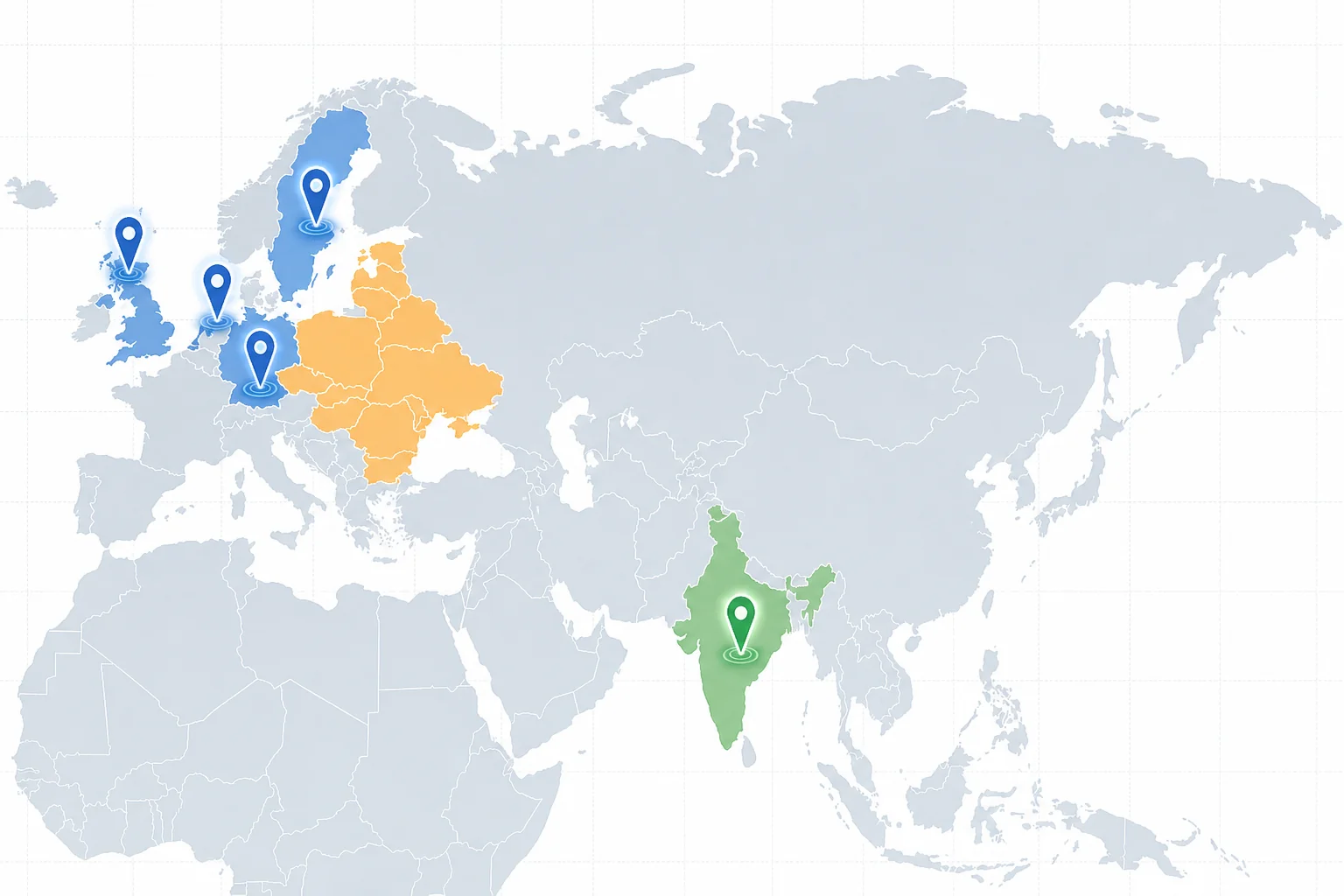
The rate gap between Western and offshore design agencies is significant, but the decision isn't purely about price. Here's how the market breaks down for founders in the UK, Sweden, Netherlands, and Ireland.
London-based design studios typically charge £90–£180/hr for senior UI/UX work. Boutique agencies in Manchester, Edinburgh, or Amsterdam tend to sit at £70–£130/hr. You're paying for local market knowledge, easy timezone alignment, and in some cases, face-to-face workshops. For highly regulated industries or products where cultural nuance in UX matters deeply, this premium can be justified.
Agencies in Poland, Romania, Ukraine, and the Czech Republic typically charge £40–£80/hr for senior design work. Timezone overlap with Western Europe is strong (CET), and design quality at the top end is genuinely competitive with Western agencies. The offshore vs nearshore comparison covers the quality and communication trade-offs in detail.
India-based studios with strong European client portfolios, like Axire Infotech, typically charge £25–£65/hr for senior UI/UX design. The rate advantage is substantial: a mid-complexity SaaS design project that costs £35,000 with a London agency might cost £9,000–£14,000 with a quality offshore partner. The key qualifier is "quality offshore partner", portfolio review, case study depth, and communication process matter enormously at this price point.
Axire Infotech's design team works specifically with European clients, which means familiarity with GDPR-compliant UX patterns, European accessibility standards (EN 301 549), and the design conventions that European users expect. You can view completed projects to assess design quality directly before engaging.
For a broader comparison of local versus international agency models, the agencies comparison guide for Sweden applies equally well to UK and broader European contexts.
Walking into an agency conversation without a budget range is one of the most common mistakes founders make. It doesn't protect you from being overcharged, it just means you have no basis for evaluating whether a quote is reasonable.
Before requesting a quote, list every screen your application needs. Group them by user role (admin, end user, guest). This gives agencies a concrete scope to price against, rather than estimating from a vague brief. Expect your screen count to grow by 20, 30% once you account for empty states, error states, and edge cases.
If you have validated user research, you can skip or reduce the discovery phase. If you don't, budget for it separately, don't let it get absorbed into a vague "design" line item where you can't track what you're getting.
Budget for at least three rounds of revisions across the project. If you're working with internal stakeholders who have strong opinions, budget for more. Revision costs are predictable if you plan for them; they're painful if you don't.
Ask every agency you speak to: what does your handoff process look like? What does a developer receive at the end of the design phase? If the answer is vague, factor in additional development time to compensate for incomplete specifications. The development timeline and cost guide explains how design quality directly affects build duration.
Real user behaviour after launch will surface UX issues that testing didn't catch. Budget for at least one round of post-launch design refinements, typically 10, 20% of your initial design spend.
Aesthetic polish is not the same as conversion performance. Some of the highest-converting web applications have relatively simple visual design, because the UX work underneath it is rigorous. Here's how to get results without inflating your design budget.
Not every screen deserves equal design investment. Your onboarding flow, your core action (the thing users come to do), and your upgrade or checkout path deserve the most attention. Secondary screens, settings pages, help sections, admin panels, can be designed more efficiently using a component library.
A design system (a library of reusable components with defined styles) costs more upfront but dramatically reduces the cost of every subsequent screen. Without one, designers recreate components from scratch for each new screen. With one, new screens are assembled from existing parts in a fraction of the time. For any project with more than 15 screens, a design system pays for itself.
Design your MVP screens first. Launch. Gather real user data. Then design the next phase based on what users actually do, not what you assumed they'd do. This approach reduces wasted design spend on features that get cut or redesigned after launch. It also aligns with how quality development partners like Axire Infotech structure agile delivery.
For guidance on how visual identity decisions affect user trust and conversion, particularly for B2B products, the digital branding guide for B2B startups covers the decisions that matter most to European buyers.
For early-stage founders, the choice between a freelancer and an agency has real cost implications. Freelancers are cheaper per hour but carry more coordination risk. Agencies bring process, but you pay for overhead. The freelancer vs agency decision framework helps European founders make this call based on their specific stage and risk tolerance.
Axire Infotech's UI/UX design service is built around conversion-focused outcomes, not just visual deliverables. Explore the UI/UX design service to see how the process is structured for web app projects.
Not all design quotes are created equal. These are the warning signs that a quote is either underscoped, overpriced, or structured in a way that will cost you more later.
A simple web app (5, 15 screens) typically takes 4, 8 weeks for a complete design cycle, including wireframes, prototype, and high-fidelity UI. A mid-complexity SaaS platform (15, 40 screens) usually takes 8, 16 weeks. Enterprise projects with full UX research phases can run 4, 6 months. These timelines assume structured feedback cycles, delays in stakeholder sign-off are the most common cause of timeline overruns.
Partially. A well-built design system with platform-agnostic components can be adapted for mobile, but mobile UI design requires separate work, different navigation patterns, touch targets, and screen constraints. Expect mobile design to add 40, 60% to your web design cost if done properly, not 10, 15% as some agencies suggest.
UX design covers research, information architecture, user flows, and wireframes, the structural and strategic work. UI design covers the visual layer: typography, colour, component styling, and pixel-level detail. Most agencies bundle both under "UI/UX design," but the ratio of UX to UI work varies significantly. For complex products, UX work should represent at least 30, 40% of total design spend.
If you have validated user insights from previous products or customer interviews, you may not need a full UX research phase. If you're building for a new user segment or entering a new market, UX research is worth the investment, it reduces the risk of building the wrong product. A targeted research phase (5, 8 user interviews plus synthesis) typically costs £2,000–£6,000 and can save multiples of that in development rework.
Compare quotes on a per-screen basis, not total cost. Divide the quoted price by the number of screens included to get a per-screen rate. Then check whether that rate is consistent with the seniority level and location of the designers involved. Also check what's included: a quote that covers wireframes, high-fidelity UI, a design system, and developer handoff is not comparable to one that covers UI screens only.
GDPR compliance adds specific UX requirements: consent flows, cookie preference centres, data deletion request interfaces, and privacy-first onboarding patterns. These add screens and complexity. For applications handling personal data, which is most web apps serving European users, budget for GDPR-specific UX work as a separate line item. It's not optional, and it's not trivial.
Understanding the true UI/UX design cost for a web app before you engage an agency puts you in a fundamentally stronger position, you can evaluate quotes accurately, negotiate from knowledge rather than guesswork, and avoid the budget overruns that come from underscoped design work.
Axire Infotech works with startups and growing businesses across the UK, Sweden, Netherlands, Ireland, and Belgium to deliver conversion-focused UI/UX design at offshore rates, without the communication friction that makes many offshore engagements frustrating. If you're scoping a web app project and want a transparent, itemised design quote, get in touch with the team to discuss your requirements. You can also view all services or explore the web development offering to understand how design and development are integrated in a single delivery process.
Let's discuss your project and create something amazing together.