A footwear brand in Manchester once got three quotes for the exact same store brief: product catalog, variant selection, cart, checkout, and a loyalty program. The lowest quote came in at £6,000. The highest was £41,000. Same document, same feature list, wildly different numbers. The founder didn't pick the cheapest one, and she didn't pick the most expensive one either. She picked the one that could actually explain, line by line, where every pound would go.
That's the real problem with e-commerce website development cost today: most founders aren't overpaying because agencies are dishonest. They're overpaying because nobody handed them a proper e-commerce website development cost breakdown before they signed anything. Money leaks out in predictable places: plugin subscriptions nobody uses after month three, custom features scoped on a napkin, servers sized for traffic that won't exist for a year, and integrations quietly left out of the original quote.
This guide breaks down exactly where that money goes, the five mistakes that inflate an online store's budget most often, and a framework you can use to scope your own project before you get your next quote.
Before you can spot overspending, you need to know what a healthy budget actually looks like. An e-commerce build generally splits across six cost categories, and each one behaves differently depending on whether you're building on a hosted platform or a fully custom stack.
Each of these categories can swing 2-3x depending on scope decisions you make early. That's exactly where the next five mistakes show up.
Plugin bloat is the quietest budget killer in e-commerce. A store owner picks a hosted platform, then adds a plugin for reviews, another for upselling, another for SEO, another for abandoned cart emails, and another for inventory sync. Individually, each one looks cheap. Stacked together, they often add up to more than a custom-built equivalent would have cost, and they keep billing every month whether the store uses them or not.
There's a technical cost too. Too many third-party plugins slow down page load times, which hurts conversion and search ranking. They also multiply your attack surface: every plugin is a potential security gap that needs its own updates and patches. [INTERNAL_LINK: website maintenance costs] becomes a much bigger number once you're maintaining a dozen overlapping tools instead of one clean codebase.
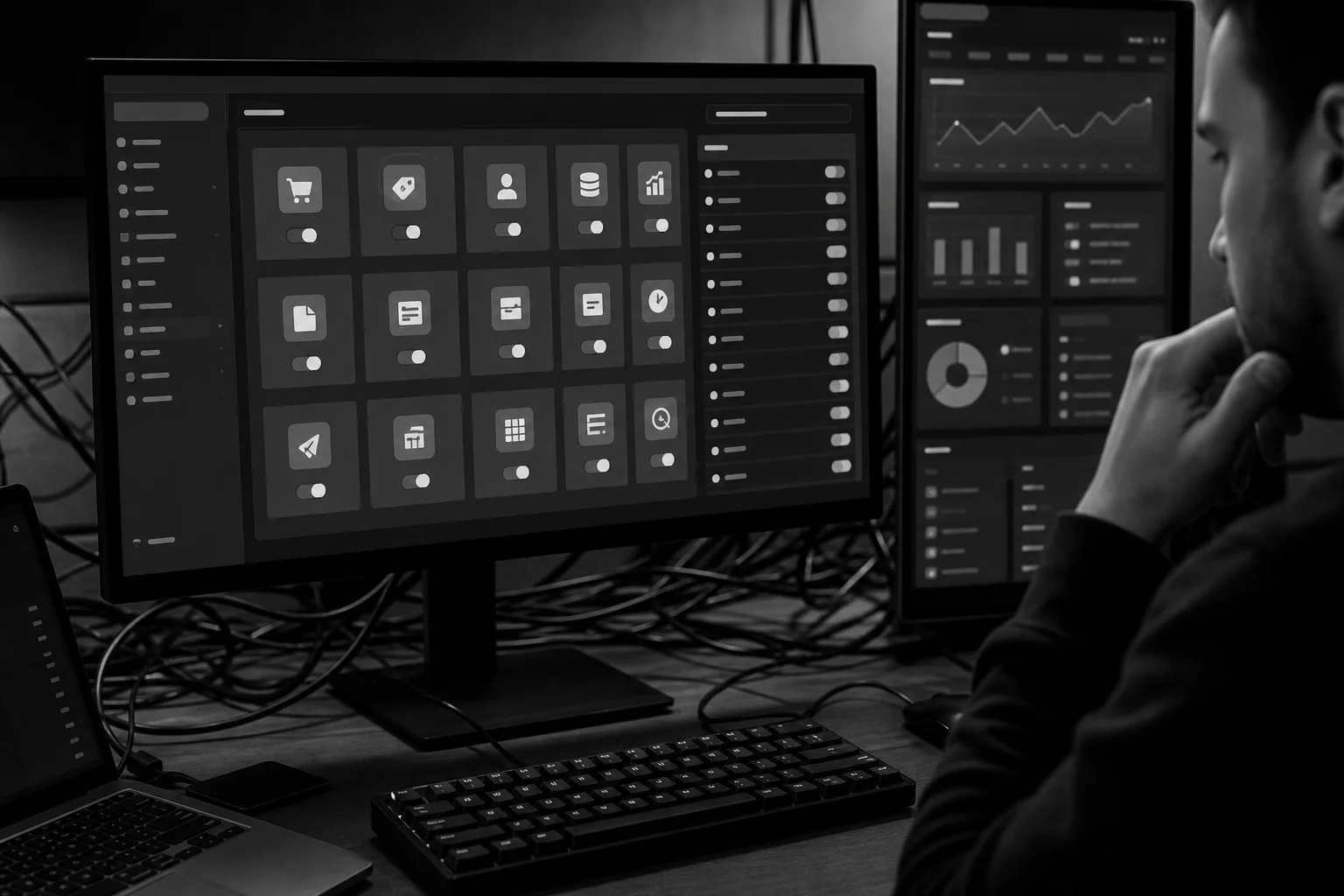
The fix isn't always "go fully custom." It's matching the build method to your actual growth stage. If you need three specific features and none of them exist as clean, well-supported plugins, custom-coding them into a lean Node.js backend or React storefront often costs less over two years than five stacked subscriptions, and you own the code outright. If you genuinely need common functionality that established plugins already do well, don't pay a developer to reinvent it. The skill is knowing which is which before you commit budget, and that's exactly what a proper project scope document should surface.
Here's where the real money disappears. A founder tells an agency, "we want a loyalty program" or "we need subscription billing," and the agency quotes based on a rough guess because nobody defined what that actually means. Does the loyalty program need tiered rewards? Does it sync with the CRM? Does subscription billing need to pause, skip, or swap products mid-cycle? Every unanswered question becomes a change order once development starts, and change orders are where quotes balloon.
We see this constantly with founders who come to us mid-project, stuck with a partially built feature that doesn't match what they actually needed. The fix is unglamorous but effective: a real discovery phase before any code gets written. At Axire Infotech, that's step one of our process for a reason. We sit down and map business goals, target audience, and exact feature requirements before design or development starts, because every hour spent clarifying scope up front saves multiple hours of rework later.
If you're building your own spec before approaching agencies, write down the exact user flow for every custom feature: what happens on click, what data gets saved, what the admin sees, and what the edge cases are (declined payment, out-of-stock item, expired discount code). Our guide on how to define project scope walks through the nine elements that stop this exact problem before it starts.
A vague feature request isn't a smaller project. It's a bigger one with an unknown price tag attached.
The opposite mistake is just as expensive. Some founders, worried about scale, insist on enterprise-grade infrastructure before they've sold a single product. They pay for auto-scaling clusters, redundant databases across multiple regions, and custom caching layers designed for tens of thousands of daily visitors, when their realistic first-year traffic is a few hundred sessions a day.
This shows up as inflated DevOps and cloud costs baked into the initial build, plus ongoing hosting bills that don't match revenue for months or years. It's the e-commerce equivalent of renting a warehouse before you've packed your first box.
The better approach is right-sizing: build on infrastructure that scales cleanly later without needing a rebuild now. Platforms like Firebase, Supabase, and managed cloud hosting let a store start lean and add capacity as orders actually grow, rather than paying for headroom you won't use for a year. This is exactly the kind of tradeoff we walk clients through in our DevOps and cloud deployment guide, and it's a decision worth revisiting anytime your timeline shifts, since development timeline directly impacts budget in ways many founders don't anticipate.
Payment integration looks simple from the outside: add a "Pay Now" button, connect Stripe, done. In practice, it's one of the most commonly under-scoped line items in an e-commerce quote. European stores usually need to support multiple payment methods, card processing through Stripe, Klarna for buy-now-pay-later, iDEAL for Dutch customers, and compliance with PSD2 Strong Customer Authentication rules across the EU and UK. Each method has its own integration logic, testing requirements, and edge cases around failed or disputed payments. Then there's everything beyond checkout. CRM syncing so sales data reaches your marketing team. ERP integration so inventory numbers stay accurate across channels. Logistics APIs for shipping rate calculation and label generation. Tax calculation services for cross-border VAT. These integrations rarely make it into an initial quote because they get treated as an afterthought, then arrive as a surprise change order once development is underway.
Our API integration FAQ covers the most common questions we get asked about this exact problem, and it's worth reading before you finalize any e-commerce scope. If you want a second opinion on your quote, our web development services page outlines exactly how we scope integrations from day one so they don't become a mid-project surprise.
Some founders try to save money by cutting the testing phase short, treating launch day as the finish line instead of a checkpoint. This almost never actually saves money. A payment bug discovered by customers costs far more in lost trust and abandoned carts than a QA pass would have cost before launch. Cross-browser issues, broken mobile checkout flows, and slow page loads all surface after real traffic hits the site, when fixing them is more expensive and more visible. The other budget most SMBs forget entirely is what happens after launch. Hosting, security patches, dependency updates, and feature refinements are ongoing costs, not one-time expenses. Our website maintenance cost breakdown lays out what these recurring bills typically look like so you can budget for year one and year two, not just launch day.
Once you understand where the money actually goes and where it typically leaks, building a realistic budget comes down to four steps.
Write out every core feature, every custom feature, and every integration you need, with as much detail as possible. Vague requests get vague, risky quotes. A detailed spec gets you accurate, comparable ones.
Not every feature needs to launch on day one. Separate "must launch with" from "add after we have real sales data." This alone can cut initial cost significantly while keeping the door open for growth. Our guide on development budget planning covers how to allocate funds across these priorities without starving the launch-critical features.
A single number tells you nothing. Ask every agency to break their quote down by design, development, integrations, QA, and post-launch support. This is the only way to compare quotes apples-to-apples, and it's the fastest way to spot an agency that's padding one line item to make another look cheap.
Set aside 15-20% of your budget for scope adjustments that surface once development starts. Then ask every agency you're considering: What's included in QA? Which integrations are quoted versus estimated? What happens if we need a change mid-build? Their answers tell you more about your future budget than the quote itself.

If you're comparing multiple agencies right now, our breakdown of how development timeline impacts cost and our local versus international agency comparison are both useful reference points before you commit.
Costs vary widely based on scope, but the pattern holds across markets: a simple store with standard catalog, cart, and one payment method costs far less than a store with custom checkout logic, multiple payment methods, and ERP or CRM integration. The gap between a basic build and a fully custom one is usually the difference between a few thousand pounds and tens of thousands, which is exactly why an itemized quote matters more than a single headline number.
If your feature set matches what a mature platform already does well, a hosted solution can get you to market faster with lower upfront cost. Once you need custom logic, unusual integrations, or a storefront experience that standard themes can't deliver, custom development on React, Next.js, or Node.js typically works out cheaper over 18-24 months, and you avoid the plugin-stacking problem entirely.
Plan for 15-20% above your itemized quote. This covers the scope adjustments that come up once real development starts, without derailing your launch date or forcing you to cut a feature you actually need.
A lean MVP-style store can launch in a matter of weeks. A fully custom build with multiple integrations, custom checkout logic, and a bespoke admin dashboard takes longer. Timeline and cost are directly linked, and stretching a timeline to cut corners on QA usually costs more later than it saves now.
Look for a team that scopes integrations and custom features explicitly in the quote, not as vague line items. Ask to see past work in our agency comparison guide, and check whether their process includes a genuine discovery phase before design work begins.
Overspending on an e-commerce build almost never comes down to one bad decision. It's plugin subscriptions that stack up, features scoped on assumptions instead of specs, infrastructure sized for traffic you don't have yet, and integrations that show up as surprises. Each one is avoidable with the right scoping process before development starts.
At Axire Infotech, our e-commerce development process starts with discovery and planning specifically to catch these issues before they become expensive. Our development team works in React, Next.js, and Node.js to build storefronts that convert, our design team handles UI/UX and prototyping in Figma, and our strategy team keeps SEO and growth in view from day one, so you're not paying twice for work that should have been scoped correctly the first time.
If you're planning an online store and want a clear, itemized web development quote instead of a lump-sum guess, or you need help scoping UI/UX design or app development alongside your store, get in touch and we'll walk through your requirements before you spend a pound. Contact Axire Infotech for a straightforward scope conversation, browse our past e-commerce projects for a sense of what's possible, or explore our full range of services to see how design, development, and strategy come together under one roof. For more budgeting frameworks like this one, visit our blog.
Let's discuss your project and create something amazing together.