A rough idea turns into a buildable product the moment someone writes down which features matter and which ones wait. How to write an MVP feature scope document comes down to four moves: define the one assumption your MVP must test, sort every feature with a simple must/should/could/won't filter, size the effort behind each item, and lock a change-control rule before your first sprint starts.
| Document Section | Purpose | Typical Owner |
|---|---|---|
| Problem statement | States the one assumption the MVP must test | Founder |
| Feature backlog | Every feature idea, unfiltered, before prioritization | Founder + product lead |
| MoSCoW breakdown | Separates must-haves from nice-to-haves | Founder + dev lead |
| Effort estimates | T-shirt sizes or story points per feature | Development team |
| User stories & acceptance criteria | Turns each feature into something a developer can build and test | Product lead + developers |
| Change-control rule | Defines how new requests get evaluated mid-build | Founder + project manager |
| Out-of-scope list | Explicitly names what the MVP will not do at launch | Founder |
Before you write a single feature line, write one sentence stating the assumption your MVP exists to test. Not a vision statement, not a mission. One testable claim, like "restaurant owners will pay monthly for automated table reservations instead of using a phone line."
Every feature you consider later gets checked against that sentence. If a feature doesn't help prove or disprove it, it doesn't belong in version one. This single filter does more to control scope than any prioritization framework you'll use afterward, because it stops the debate before it starts.
Founders who skip this step tend to build a small version of their full product instead of a focused test of their riskiest idea. The two look similar on a roadmap but behave very differently in a budget review three months later.
Write down every feature anyone on the team has mentioned, no matter how small or ambitious. Do this in one sitting, without discussing feasibility or cost. The goal is a complete list, not a good one.
Mixing ideation and judgment in the same conversation is where most scope documents go wrong. People self-censor good ideas because they assume they're too expensive, and expensive ideas survive because nobody challenged them yet. Separate the two steps entirely.
Most early-stage lists land between 25 and 60 feature ideas. That's normal. The next step exists specifically to cut that number down.
The MoSCoW method sorts features into four columns: Must-have, Should-have, Could-have, and Won't-have for this release. A feature only earns "Must-have" if the MVP fails its core test in section one without it.

Run each feature idea through one question: "If we launch without this, can we still learn whether our core assumption is true?" If yes, it moves to Should-have or lower. If no, it stays in Must-have.
Most viable MVP scopes land on 5 to 8 must-have features. Anything past 10 usually signals the problem statement from section one was too broad, or the team hasn't been honest about what "must" actually means.
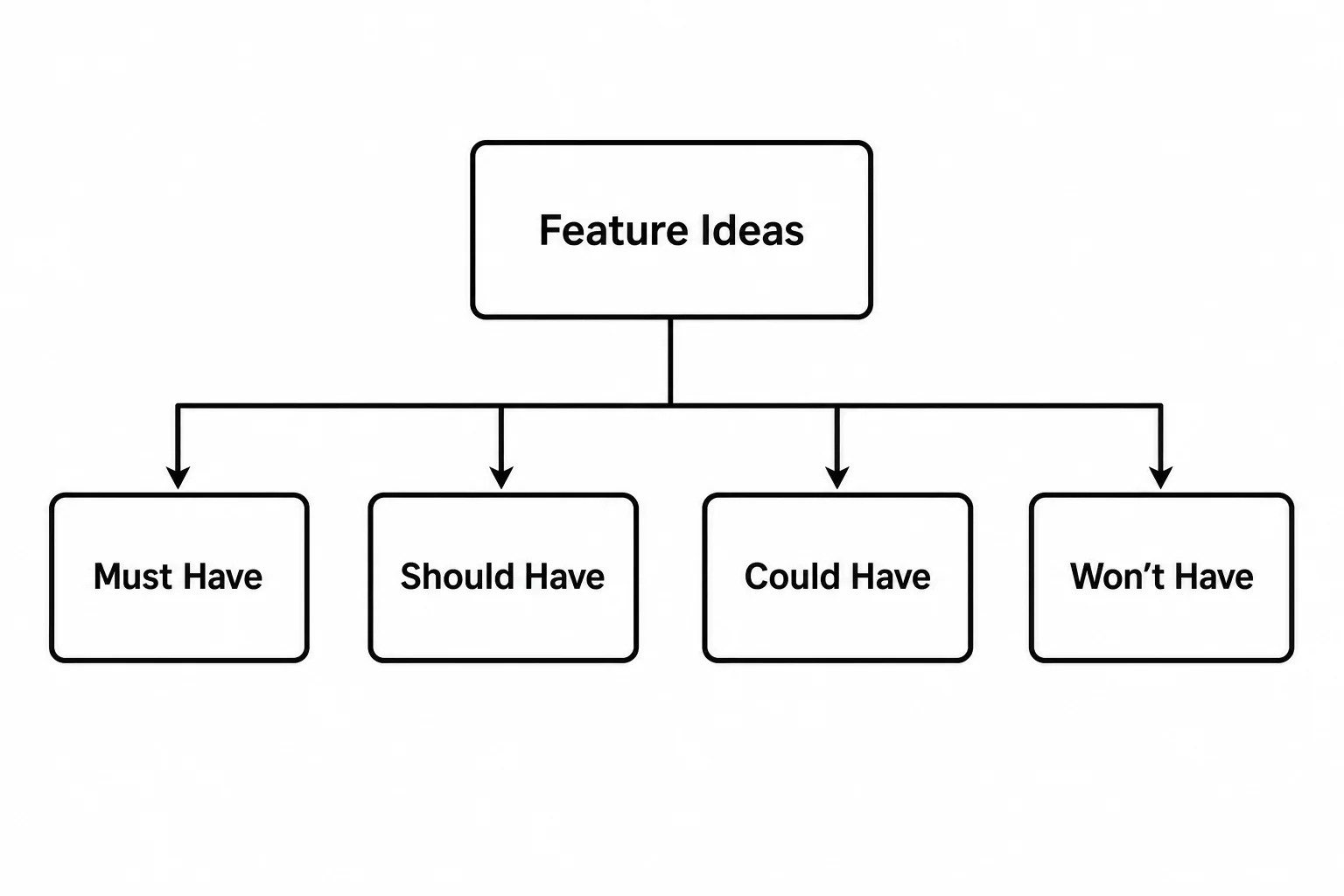
Keep the Won't-have column visible, not deleted. Writing down what you're deliberately not building gives stakeholders a clear answer when someone asks "what about X?" later in the project. That single list has stopped more scope arguments than any meeting.
Once your must-haves are locked, size each one individually using rough T-shirt sizes: Small, Medium, Large, or Extra-Large. This is not a full estimate, it's a gut-check that surfaces the features quietly eating your whole budget.
A "must-have" login flow might be Small. A "must-have" real-time chat feature might be Extra-Large. Seeing that gap in writing, before development starts, gives the founder a real choice: keep the feature and adjust budget, or find a smaller version that still tests the assumption.
During Discovery & Planning, Axire's development team sizes each feature against the actual tech stack being proposed, whether that's React and Node.js for a web app or React Native for a cross-platform mobile build. Sizing against real tools, not guesswork, is what separates a usable scope document from a wish list.
A feature scope document that skips effort estimation isn't a scope document, it's a hope document.
A one-line feature name like "user onboarding" tells a developer almost nothing. Each must-have feature needs a short user story and a testable acceptance criterion: "As a new user, I can complete signup in under 90 seconds using email or Google, and I see a confirmation screen when done."

Acceptance criteria give both sides a shared definition of "finished." Without them, a developer marks a feature complete and the founder disagrees, and that disagreement usually surfaces during QA, the most expensive place to catch it.
List obvious edge cases too: what happens if a payment fails, what a user sees with a slow connection, what an empty state looks like before any data exists. These details are small individually but add up to real rework if left undocumented.
Scope creep rarely arrives as one big request. It arrives as a dozen small "can we just also add" moments spread across a build. Each one sounds reasonable alone; together they can push a four-week MVP into eight weeks without anyone deciding that on purpose.
Set a simple rule before development starts: any new feature request during the build gets evaluated against the original must-have list, and if it's added, something else of equal size gets removed or pushed to a later release. This swap-in, swap-out rule keeps the founder in control of trade-offs instead of discovering them after an invoice.
Put this rule in writing inside the scope document itself, not in a side conversation. A written rule survives staff changes and founder fatigue. A verbal agreement usually doesn't.
A written MVP feature scope document is the core deliverable of a Discovery & Planning phase: it's what turns founder conversations into a document the design and development teams can actually start from. It sits between the initial consultation and the first wireframes.
At Axire, this phase runs as structured consultation work: understanding business goals, target users, and constraints, then documenting the answer as a prioritized feature list rather than meeting notes. That document then feeds directly into Design & Prototyping, where wireframes and interactive mockups get built around the confirmed must-haves, not a moving target. For a closer look at what this phase includes, see our MVP development FAQ for startups.
Skipping it usually means the build starts against a verbal or half-written idea, and the team discovers disagreements about "must-have" mid-sprint instead of before it. That leads to rework, missed timelines, and budget conversations nobody planned for.
The pattern is predictable: a feature everyone assumed was included gets flagged in week three, timeline slips two weeks to accommodate it, and the original budget no longer covers the agreed build. A scope document doesn't prevent every disagreement, but it moves the disagreement to before the invoice starts running instead of after. If you're also weighing what a build like this actually costs, our MVP development questions guide and a look at how development timelines affect budget cover that ground in more depth.
Use this as a working checklist before you send a scope document to any development partner:
A document that hits every item on this list is ready to hand to a development team, whether that's an in-house hire, a freelancer, or an agency. If your scope also involves connecting to external systems, our guide on choosing the right tech stack for your web project is worth reading alongside this one, since stack choice and feature scope should be settled together, not separately.
For reference, the Agile Alliance's documentation on the MoSCoW method and the U.S. General Services Administration's Minimum Viable Product guidance both cover the underlying prioritization logic in more technical detail than this post.
A tight scope document is the difference between an MVP that ships on time and one that quietly grows past its budget before anyone notices. If you'd rather have a development team run this process with you instead of building the document alone, Axire's web development and app development teams handle Discovery & Planning as the first paid milestone of every project, not a free extra. You can see how that process plays out across past builds in our project work, or browse all our services to see where scoping fits your specific build. When you're ready to turn your feature list into a real project plan, contact Axire to start a Discovery & Planning conversation.
Let's discuss your project and create something amazing together.