A React Native app development company should give you three things in writing before any contract is signed: full codebase ownership at handover, a documented testing process that covers real devices (not just emulators), and a clear answer for who submits your app to the App Store and Play Store. Skip any one of these and you risk a rebuild within a year.
| Question Category | What to Ask | Red Flag Answer | Why It Matters |
|---|---|---|---|
| Codebase ownership | Do we own the repo, licenses, and credentials at launch? | "We retain rights to reusable components" | You could be locked into the vendor for future updates |
| Native modules | Which native modules have you shipped for camera, payments, push? | "We haven't needed custom native code yet" | Most real apps need at least one native bridge |
| Testing process | Can you show a sample test plan with real-device coverage? | "We test on emulators, it's usually fine" | Emulators miss camera, GPS, and performance bugs |
| App store submission | Who owns the developer accounts, and what's your rejection turnaround? | "We'll create accounts under our name" | You lose control of your own app listing |
| Team structure | Who specifically is assigned to my build? | "Whoever's free that sprint" | Context-switching developers slow delivery and raise bug counts |
| Discovery phase | What does discovery actually produce, on what timeline? | "We can quote a fixed price today" | Fixed quotes without discovery usually balloon in scope |
| Contract terms | What happens if the relationship ends mid-build? | No escrow or handover clause offered | Protects you if the vendor becomes unresponsive |
Cross-platform apps promise one codebase for iOS and Android, and React Native usually delivers on that promise when it's built by people who've done it before. The catch is that "React Native experience" covers a wide range, from teams that ship polished apps for fintech clients to teams that copy a tutorial and call it a product. The questions below separate the two.
You should own the full repository, every third-party license, and all admin credentials the moment the project completes, spelled out in the contract before work starts, not negotiated after the fact.
Some agencies quietly retain rights to "reusable internal components" they built for your app. That clause sounds harmless until you try to switch developers and discover a chunk of your own app's logic isn't actually yours to modify.
Ask for the repository transfer to happen on a rolling basis, not as a single dump at the very end. A vendor that pushes commits to a repo you control from day one, rather than their own private repo, removes the entire question.
Also check third-party package licensing. React Native apps lean on open-source libraries for navigation, state management, and native bridges. Most are MIT-licensed and fine, but a handful carry restrictions that matter if you plan to resell or white-label the app later.
React Native runs your app logic in JavaScript but still needs native Swift or Kotlin code, called a "bridge," for camera access, biometric login, push notifications, and most payment SDKs. A team that has never written a custom native module will hit a wall the first time your feature list needs one.
Ask for two or three examples of native modules they've built or integrated: a payment SDK, a background location tracker, a custom camera flow. Vague answers here usually mean the team has only built simple CRUD apps that stayed inside Expo's managed workflow.
Expo itself isn't a red flag. It speeds up development significantly and Axire Infotech uses it where it fits. The problem is a team that can't tell you when you'll need to "eject" from managed Expo into a bare React Native workflow, because that transition, done late, can force a partial rebuild.
Push them on version strategy too. React Native ships frequent updates, and a company still running a two-year-old version on a new project is a sign of technical debt they haven't addressed for their own tooling, let alone yours.
A credible testing process covers real devices across multiple iOS and Android versions, automated unit tests for business logic, and a manual QA pass before every release, documented in a test plan you can review before signing.
The single most common cross-platform pitfall is a team that tests exclusively on simulators and emulators. Simulators don't reproduce real camera behavior, GPS drift, low-memory conditions, or the input lag on a three-year-old Android device. An app that looks flawless in a demo can crash on the phone your actual users own.

Ask specifically which physical devices they test on, and whether they use a device farm service or an in-house device library. Also ask how they handle platform-specific UI differences, since a button that looks right on iOS can sit oddly on Android's Material Design conventions if nobody checked.
Your development partner should submit the app under developer accounts you own, and commit in writing to a resubmission timeline if Apple or Google rejects the build on first pass.
Apple's review process rejects a meaningful share of first submissions over guideline issues: incomplete metadata, missing privacy disclosures, or UI that doesn't match screenshots. Google Play's review is generally faster but has its own policy quirks around permissions and data collection disclosures.
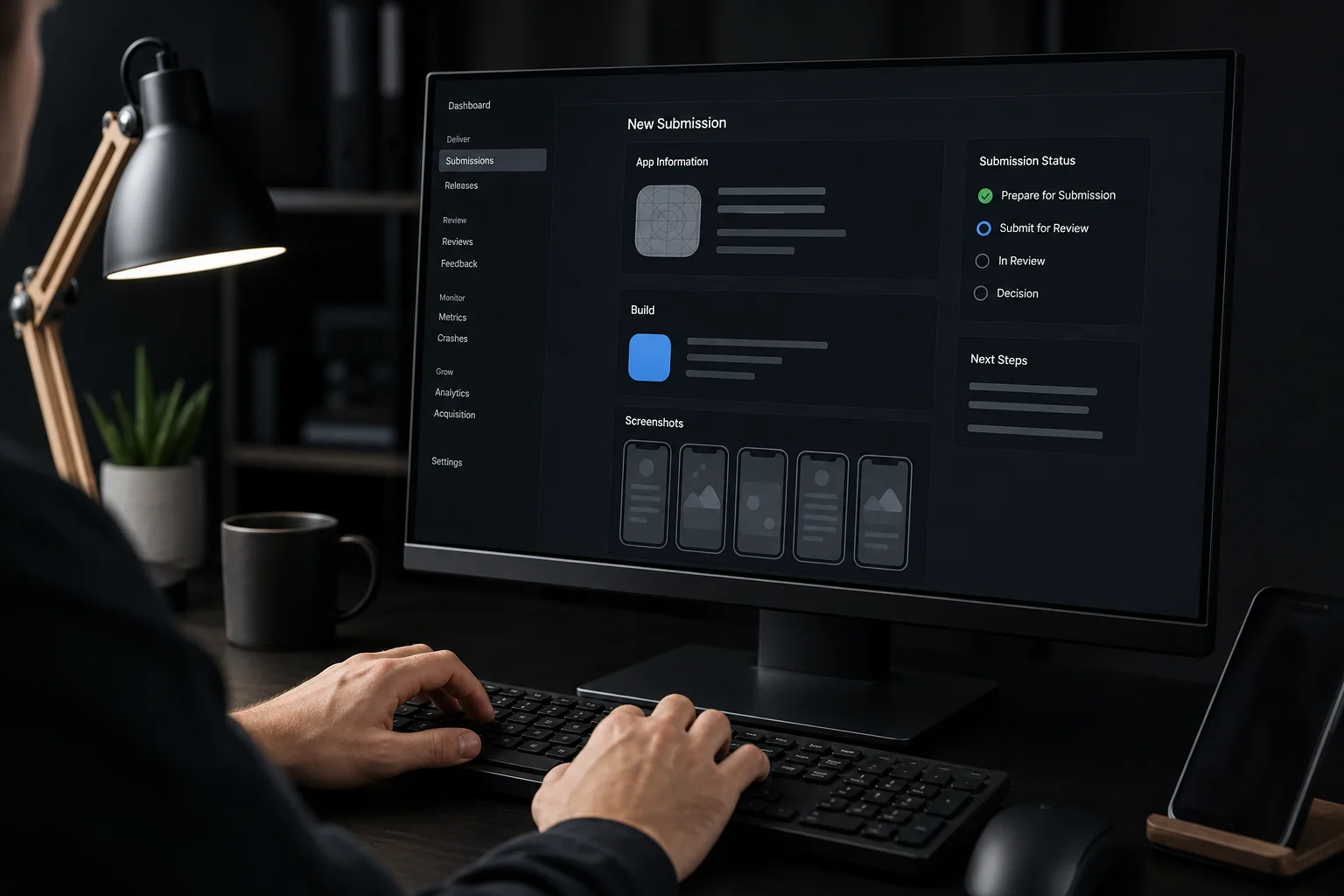
Ownership of the developer accounts matters more than most founders expect. If the agency creates the Apple Developer and Google Play accounts under their own business name, you don't control your own app listing, can't respond directly to user reviews under your brand, and face a painful transfer process if you ever switch vendors.
Ask directly: "Will the accounts be registered to my company from day one?" If the answer is anything other than yes, treat it as a negotiation point, not a minor detail.
A dedicated team means named developers, designers, and a project lead assigned specifically to your build, with a defined weekly communication cadence, rather than a shared pool of engineers pulled across multiple client projects at once.
This question matters because context-switching is expensive. A developer juggling three unrelated codebases in a single day introduces more bugs and takes longer to fix them than one focused on your app. Ask how many concurrent projects each developer on your team is assigned to.

For European founders specifically, timezone overlap decides how fast decisions get made. A team with zero working-hour overlap turns every clarification question into a 24-hour round trip. Axire Infotech structures its development, design, and strategy teams to overlap with CET afternoons, which keeps daily standups and quick approvals moving without waiting until the next day.
If you're weighing a dedicated pod against hiring individual freelancers, the trade-off usually comes down to accountability: a structured team has a project lead who owns delivery, while a freelancer collective often doesn't. For a deeper look at team models, see how to evaluate a development partner.
A real discovery phase produces written wireframes, a technical architecture document, and a locked feature scope over one to two weeks, before any fixed-price quote is issued.
Skipping discovery is the fastest route to a scope dispute six weeks into the build. If a company quotes you a fixed price on your first call, without asking about your target platforms, backend requirements, or third-party integrations, that number is a guess dressed up as a commitment.
During discovery, expect the team to ask about your target audience, which native features you need (camera, push notifications, offline mode), your existing backend or whether one needs to be built, and your timeline constraints. The output should be specific enough that a different development team could pick it up and understand exactly what's being built.
Read more about what a properly run discovery process should cover in the broader Axire Infotech blog, where discovery-phase mechanics are broken down step by step.
Beyond the categories above, a few specific failure patterns show up repeatedly in React Native projects built by less experienced teams. Ask about each one directly.
iOS and Android have different navigation conventions, font rendering, and gesture expectations. A team that builds one UI and ships it identically to both platforms often produces an app that feels slightly wrong on whichever platform wasn't the primary design target.
Android's device fragmentation means your app needs to run acceptably on hardware several years old, not just the latest flagship phone. Ask how they profile performance and what their minimum supported OS version is.
React Native's ecosystem moves fast, and some popular packages stop receiving updates. A dependency that breaks after an OS update, with no maintainer left to fix it, can stall your app indefinitely. Ask how they vet package health before adding a dependency.
These features touch both native platforms and backend infrastructure, and they're commonly under-scoped in initial quotes. Confirm whether push notification setup and deep linking are included in the base price or billed as extras later.
Webflow-style no-code tools work well for marketing sites and simple web apps, but they don't extend to native mobile builds the way founders sometimes assume. If your roadmap includes an actual iOS and Android app, a no-code web platform won't get you there.
The comparison matters because some businesses start with a Webflow site, hit its ceiling on custom functionality, and then need to decide whether to migrate the web layer to custom code before building the mobile app, or run both in parallel. There's no universally right order here. It depends on whether your mobile app needs to share a backend with your website, in which case aligning both on a custom Node.js or Next.js backend from the start avoids duplicate integration work later.
For businesses still deciding between platforms for the web side, the tradeoffs are covered in more depth on custom development approaches at how to choose the right tech stack for your web project.
Yes, typically 30-40% less than building separate native iOS and Android apps, because one JavaScript codebase covers both platforms instead of two independent teams writing Swift and Kotlin separately.
The savings shrink if your app needs heavy platform-specific native code, since those parts still require dedicated native development regardless of the framework.
A focused React Native MVP with core features typically takes 8 to 14 weeks from discovery to app store submission, depending on how many native integrations (payments, push, camera) are included in scope.
Yes, migration is possible and common when a business wants to consolidate two separate native codebases into one, though it requires a fresh discovery phase to map existing features before any code is rewritten.
Migration timelines vary widely based on app complexity, and a team unwilling to commit to a discovery phase before quoting a migration price is worth questioning, for the same reasons outlined above.
Vetting a React Native app development company properly, before signing anything, is the cheapest insurance you'll buy on the entire project. Axire Infotech runs every mobile build through a documented discovery, design, development, and launch process, with named developers on your team and full codebase ownership handed to you at completion. If you're comparing vendors for your next cross-platform build, see how our app development process works, or get in touch to walk through your project scope before you commit to anyone.
Let's discuss your project and create something amazing together.