You reduce app development costs by cutting scope, not standards: trim the feature list to what the first release must prove, build cross-platform instead of two native teams, right-size the architecture for the users you actually have, and insist on a line-item quote before anyone writes code. Do those four things and you can land 30-50% under an uncontrolled build, without touching testing or code quality.
| Cost Lever | What Wastes Money | What Saves Money | Typical Impact |
|---|---|---|---|
| Feature scope | Building the full roadmap before launch | Phased MVP with a must/should/could split | Cuts first-release build size roughly in half |
| Platform strategy | Separate iOS and Android native teams | Shared React Native codebase | 40-70% lower 3-year total cost |
| Architecture | Microservices for 100 users | A modular, well-tested single service | Fewer moving parts, faster ship time |
| Quoting | Single lump-sum number | Line-item quote with named exclusions | Fewer change-order surprises |
| Discovery | Skipping it to "save" a week | A short, structured discovery phase | Avoids rebuild costs later |
| QA and testing | Treated as optional to cut cost | Kept fixed regardless of scope cuts | Protects launch quality |
Most app budgets don't blow up because a developer charged too much per hour. They blow up because nobody said no to a feature early enough. A founder pitching investors adds a referral system, a loyalty program, and an admin dashboard before a single customer has used the core app.
Every one of those additions costs development time, design time, and QA time, as AST Consulting notes in their breakdown of mobile cost drivers. None of it validates whether the product actually works.
Scope creep is one leak. Native duplication is another: building separate iOS and Android apps when your user base doesn't yet justify two codebases. Over-engineering is the third, sizing your infrastructure and architecture for scale you might reach in year three, not the scale you have on launch day.
The fourth is quieter but just as costly: a quote that hides scope in a single number, so nobody notices the rework charges until the invoice arrives.
You reduce cost by removing waste upstream, not by lowering the bar downstream. That means validating demand before building, phasing your MVP, choosing an architecture you can actually afford to maintain, and catching defects before they reach production, a sequence Jhav Tech's cost-reduction framework lays out clearly. The four levers below are where that discipline actually plays out in a real project.
Before you write a single ticket, sort every proposed feature into three buckets: what a user cannot complete their core task without, what would help but isn't essential, and what can wait. EngineerBabu's research found a focused MVP build typically lands 40-60% under an unscoped one.
That gap isn't a discount on quality. It's the cost of features you were never going to ship on day one anyway. The trick is writing that split down formally, not deciding it in a hallway conversation, so the version 2 backlog is a real plan and not a place features go to die.
If you haven't done this exercise yet, our guide on building an MVP on a budget without cutting corners walks through the must/should/could split in detail, and our MVP development cost breakdown for 2026 shows what's actually negotiable in a quote once that scope is locked.
Two native teams means two codebases, two release cycles, two QA processes, and two sets of platform-specific bugs. A shared React Native codebase collapses that into one team and one release cycle, which usually cuts the long-term cost of ownership.

Native still wins in specific cases: apps leaning hard on device-specific hardware, or products where platform-perfect animation is the entire value proposition. For the vast majority of SMB and startup apps, a booking system, an inventory tool, a customer portal, React Native delivers the same user experience on both platforms from one codebase, and it's the approach we use across our app development work.
A microservices architecture built for a hundred thousand concurrent users costs real engineering hours to design, test, and deploy, hours spent on infrastructure instead of features, when your actual user count is measured in the dozens. That complexity has to be maintained forever, by whoever inherits the codebase after launch.
The right-sized approach for most early-stage products is a well-tested, modular single service that can split into microservices later, once traffic actually demands it. That's not cutting quality. It's not paying in advance for a problem you don't have.
A lump-sum number with no breakdown hides the two things you need to see: what's actually included, and what triggers a change order. LOW/CODE's guide to cost control makes the point directly: cutting scope without cutting it deliberately kills the product, and an opaque quote is exactly how scope gets cut by accident.
Ask for hours attached to named features, a stated pricing model, and an explicit list of exclusions. If a vendor won't give you that, treat it as a sign the eventual invoice will look nothing like the estimate. We cover the full vetting process in what to ask a React Native app development company before you sign.
Not every project should default to React Native. The table below lays out where each approach actually fits, so the decision is about the product, not habit.
| Approach | Best For | Relative Cost | Quality Trade-Off |
|---|---|---|---|
| Native (Swift/Kotlin) | Hardware-heavy apps, platform-exclusive UX | Highest (two teams) | Best possible platform fit, slowest to ship |
| React Native | Booking, inventory, SaaS, e-commerce apps | Moderate, one team | Near-native feel, single codebase to maintain |
| Low-code / no-code | Simple internal tools, early validation | Lowest upfront | Hits limits fast on custom logic and scale |
A discovery phase that saves money is short, structured, and produces a written scope document before development starts, not a vague call that gets skipped to save a week. It typically covers business goals, target users, and a first-cut feature list agreed by both sides.
Skipping discovery to save time is the single most common way a project ends up rebuilding work already paid for. Our detailed walkthrough of how the discovery phase actually works covers what a proper one should produce before you approve a single sprint.
Consider a hypothetical spa chain founder pitching a booking app with online payments, staff scheduling, a loyalty program, push notifications, and an admin analytics dashboard, all before a single client has booked an appointment through it.
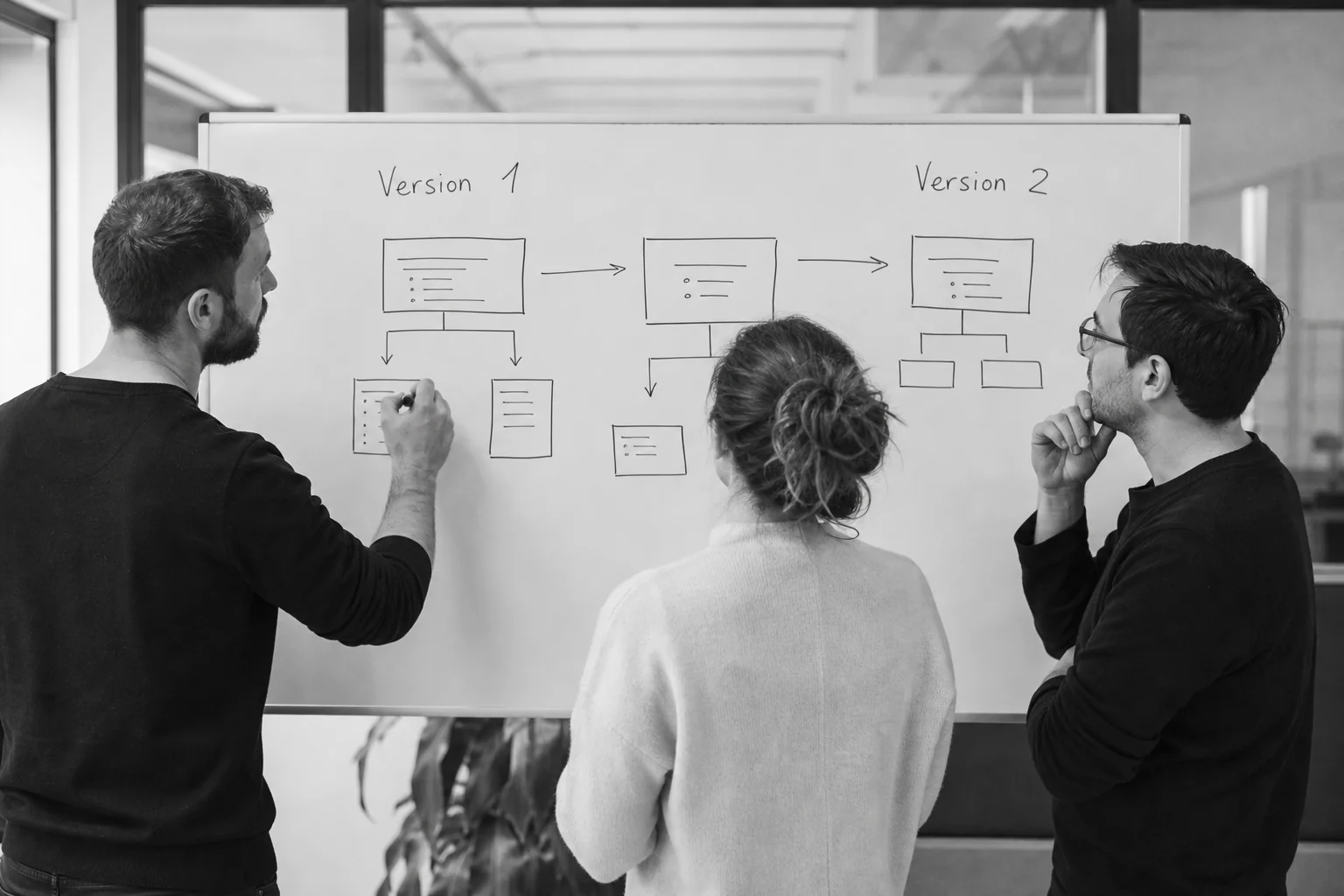
Sorted through the must/should/could framework, the first release keeps booking, payments, and staff scheduling, the three things a customer cannot use the app without. Loyalty, push notifications, and analytics move to a version 2 backlog, built once real bookings prove the core loop works.
That cut doesn't touch testing, security, or code review. It removes three features nobody has validated demand for yet, which is exactly the kind of scope Foresight Mobile's cost-saving guide flags as the expensive kind: built to impress, not built to learn. For salon and spa-specific booking logic, our booking app development guide for salons and spas goes deeper into what a first release should actually include.
A few warning signs tend to show up before a quote turns into an overrun. Watch for these when comparing agencies, whether you're evaluating a UK studio, a European one, or an offshore team:
For a broader checklist beyond app-specific costs, see our guide on how to choose a mobile app development agency in 2026.
India-based teams generally offer lower hourly rates than Poland-based teams, while Poland offers closer time-zone alignment to Western Europe. For UK and Irish founders comfortable with an afternoon overlap window, an India-based team like Axire Infotech can deliver the same React and Node.js stack at a lower total cost without a quality gap, provided the vendor has verifiable senior-level work.
A discovery phase turns a rough idea into a written scope document: business goals, target users, a first-cut feature list, and rough timeline estimates, agreed before any code is written. It's the step that prevents mid-project scope disputes and the rebuild costs that come with them.
Ask upfront for a fixed sprint cadence with a written summary at the end of each one: what shipped, what's blocked, and what's next. A partner unwilling to commit to that cadence in writing before the contract is signed is unlikely to volunteer it once the project is underway.
Cutting app development costs comes down to removing waste before a single line of code gets written, not asking a developer to work faster or skip testing later. If you're scoping a build and want a line-item quote instead of a guess, get in touch with Axire Infotech and we'll walk through what a phased build looks like for your product.
You can also browse our past projects or explore our full range of services, from UI/UX design to web development, to see how each piece fits into a cost-controlled build.
Let's discuss your project and create something amazing together.