Ask a development agency to quote for an API integration and you'll almost certainly receive a single number. No line items. No explanation of what's driving the price. Just a figure that could be anywhere from €2,000 to €80,000 depending on who you asked and what assumptions they made. For businesses across the UK, Netherlands, Ireland, Germany, and Belgium, this opacity makes it nearly impossible to plan a realistic budget — or to know whether the quote in front of you is fair.
This guide cuts through that ambiguity. Below, you'll find realistic API integration cost ranges broken down by the four use cases European businesses encounter most often: payment gateways, CRM connectors, ERP bridges, and last-mile logistics APIs. For each category, we explain what drives the price up, what keeps it down, and which shortcuts carry long-term risk. By the end, you'll have the vocabulary and the benchmarks to compare agency quotes on equal footing.
The core problem is that "API integration" describes a spectrum of work, not a single task. Connecting a Stripe payment form to a checkout page is a fundamentally different project from building a real-time, bi-directional sync between a custom web application and SAP. Both are called "API integrations." Neither costs the same.
Most agencies quote a blended rate that bundles discovery, development, testing, and deployment into one number. That approach protects the agency from scope creep, but it leaves you with no visibility into which part of the work is expensive and why. When you receive three quotes that differ by a factor of four, you have no way to tell whether the cheapest one is efficient or dangerously under-scoped.
The sections below give you the cost anatomy for each major integration category. Before diving into use cases, it helps to understand the underlying factors that drive API integration cost across all of them.

Regardless of which system you're connecting, the same technical variables determine how much the work costs. Understanding these factors lets you ask better questions before you sign anything.
Simple API key authentication is fast to implement. OAuth 2.0 flows, SAML-based SSO, or multi-tenant token management add meaningful hours. If the third-party system uses a non-standard or poorly documented auth mechanism, expect discovery time to double.
Passing a small payload from one system to another is straightforward. Transforming, normalising, and validating large or complex data structures — especially when field names, data types, or formats differ between systems — adds significant development and testing time.
Webhook-driven integrations (where the third-party system pushes events to your application) are generally more efficient but require your infrastructure to expose reliable endpoints. Polling architectures (where your system periodically requests updates) are simpler to build but create load and latency. The right choice depends on the vendor's capabilities and your data freshness requirements.
A basic integration that works in ideal conditions is cheap to build. A production-grade integration that handles rate limits, retries failed requests, queues messages during outages, and alerts your team when something breaks is considerably more expensive, and considerably more valuable.
For European businesses, data protection obligations affect integration architecture directly. If personal data flows between systems, you need to ensure lawful basis, data minimisation, and, in some cases, that data doesn't leave the EEA. These requirements add design and legal review time that purely technical quotes often ignore. For a deeper look at how compliance affects development budgets, see our guide on website maintenance costs in 2026, which covers ongoing compliance obligations in detail.
Third-party APIs change. Vendors deprecate endpoints, update authentication flows, and release breaking changes. The integration you build today will require maintenance, and the cost of that maintenance should be factored into your total budget from day one.
Payment integrations are the most common API project European businesses undertake, and they vary more in cost than most people expect. The gap between a basic card payment form and a fully featured payment infrastructure is substantial.
The most frequently integrated payment providers across the UK, Netherlands, Ireland, Belgium, and Germany include Stripe, Mollie, Adyen, Klarna, and local methods like iDEAL (Netherlands), Bancontact (Belgium), and SEPA Direct Debit. Each has a different API quality, documentation standard, and integration complexity.
Strong Customer Authentication (SCA) under PSD2 is a significant cost driver that many businesses underestimate. Implementing 3D Secure 2.0 correctly, including exemption logic, frictionless flows, and fallback handling, adds meaningful development and testing time. PCI-DSS compliance requirements also affect architecture: using hosted payment fields or tokenisation reduces your compliance scope, but integrating those correctly still takes time.
Refund flows, partial captures, dispute webhooks, and multi-currency settlement logic each add scope. If you're building a marketplace or platform where you need to split payments between sellers, expect costs to climb toward the upper end of the ranges above. For context on how payment integration fits into broader e-commerce budgets, our development budget planning guide covers how to allocate funds across interconnected project components.
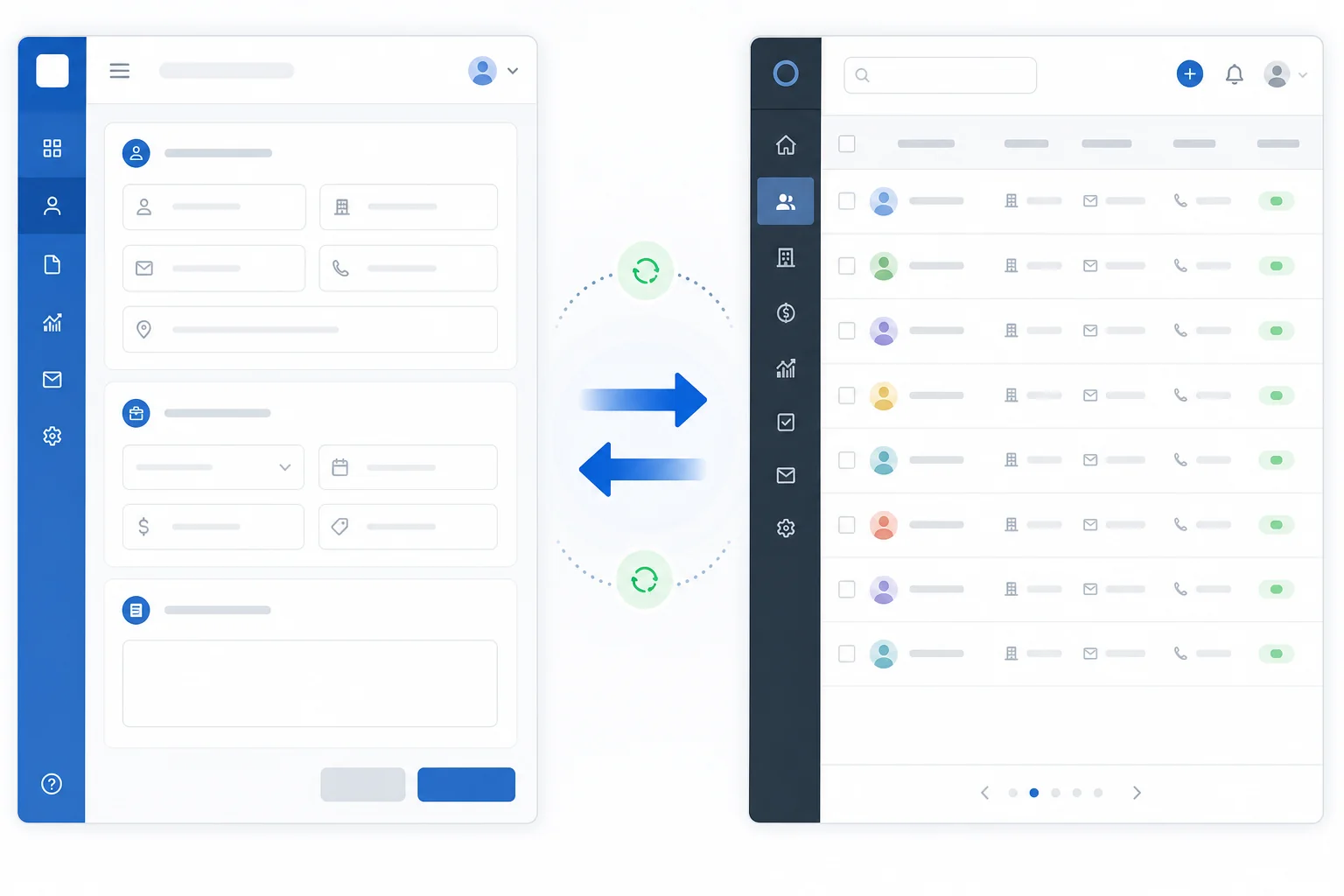
CRM integrations are the second most common request from European SMBs and enterprises. The goal is usually to keep customer data consistent between a web application, e-commerce platform, or custom tool and the CRM the sales or marketing team lives in.
The most frequently integrated CRM platforms across European markets include HubSpot, Salesforce, Pipedrive, Microsoft Dynamics 365, and Zoho CRM. HubSpot and Pipedrive have well-documented REST APIs that are relatively straightforward to work with. Salesforce and Dynamics 365 have powerful but complex APIs that require more specialist knowledge.
The biggest cost driver in CRM integrations is data model mismatch. When your application's data structure doesn't map cleanly to the CRM's standard objects, you need custom field mapping logic, transformation layers, and careful conflict resolution rules for bi-directional syncs. Deciding what happens when the same record is updated in both systems simultaneously, and building the logic to handle it, is non-trivial work.
API rate limits are another hidden cost. Salesforce, for example, enforces strict API call limits per 24-hour period. If your integration needs to sync large volumes of records, you may need to build a queuing system that batches requests and respects those limits. That architecture adds cost but is essential for production reliability.
Legacy CRM versions with SOAP-based APIs (still common in some Dynamics 365 deployments) are significantly more expensive to integrate than modern REST APIs. If your CRM is more than five years old, factor in additional discovery time.
ERP integrations are consistently the most expensive category in this guide, and for good reason. Enterprise Resource Planning systems sit at the centre of a business's operational data: inventory, finance, procurement, HR, and manufacturing. Getting data in and out of them reliably, accurately, and securely is technically demanding work.
The most widely deployed ERP systems across the UK, Netherlands, Germany, Belgium, and Ireland include SAP S/4HANA, Microsoft Dynamics 365 Business Central, Exact Online (particularly popular in the Netherlands and Belgium), Odoo, and NetSuite. Each has a different integration approach, API maturity, and documentation quality.
Three factors push ERP integration costs above other categories. First, data governance requirements: ERP data is often the system of record for financial and operational data, meaning errors have real business consequences. Audit trails, reconciliation logic, and rollback mechanisms are not optional. Second, middleware complexity: many ERP integrations require an intermediary layer, either a custom-built integration service or an iPaaS platform, to handle transformation, routing, and error management. Third, testing overhead: ERP test environments are often difficult to access, expensive to provision, and don't always mirror production data accurately, which extends QA timelines significantly.
For businesses evaluating whether to use an iPaaS platform like MuleSoft or Azure Integration Services versus custom-built middleware, the platform licensing cost is real but so is the long-term maintenance advantage. Custom middleware is cheaper upfront but requires your development team to maintain it indefinitely. Our DevOps and cloud infrastructure guide covers how to evaluate build-vs-buy decisions for integration infrastructure.
Most ERP integrations don't need to be real-time. Syncing orders every 15 minutes is sufficient for most e-commerce operations. Choosing batch sync over real-time event streaming can reduce development cost by 30-40% while still meeting business requirements. Push back on any agency that defaults to real-time without justifying why your use case requires it.
For European e-commerce businesses and retailers, logistics API integration is often the third pillar after payments and CRM. The goal is to automate label generation, provide customers with live tracking, and, increasingly, manage returns programmatically.
The most frequently integrated carriers and logistics platforms across European markets include DHL, PostNL (dominant in the Netherlands), DPD, GLS, Royal Mail (UK), and aggregator platforms like Sendcloud and Shippit. Aggregator platforms are worth considering: they provide a single API that connects to multiple carriers, which can significantly reduce integration cost if you need multi-carrier support.
Carrier API instability is the defining challenge of logistics integrations. Unlike payment or CRM APIs, carrier APIs are often poorly documented, inconsistently versioned, and prone to unannounced changes. DHL's API, for example, has gone through multiple breaking version changes in recent years. Building robust error handling and fallback logic is not optional, it's the difference between an integration that works in testing and one that works in production at peak season.
Returns management adds disproportionate complexity. Generating a return label is straightforward. Building a returns portal that coordinates between your e-commerce platform, the carrier, your warehouse management system, and your customer service team is a multi-system integration project in its own right.
For businesses building e-commerce platforms with logistics integration, the API integration FAQ covers common questions about carrier API reliability and how to structure contracts with agencies for ongoing maintenance.
Beyond the use-case-specific factors above, several cross-cutting costs appear in almost every integration project and are rarely itemised in agency quotes.
For a broader view of how hidden costs accumulate across digital projects, our development timeline and cost guide explains how project duration directly affects total budget, a dynamic that's especially relevant for complex integration work.

Receiving three quotes that differ by a factor of five is not unusual for API integration projects. The question is how to evaluate them without technical expertise. Here's what to look for.
A well-structured integration quote should break down costs across at least these phases: discovery and technical scoping, authentication and connection setup, data mapping and transformation logic, error handling and retry architecture, testing (unit, integration, and end-to-end), deployment and documentation, and a defined maintenance period. If a quote presents a single number without this breakdown, ask for it explicitly before proceeding.
Fixed-price contracts work well for well-scoped integrations where the third-party API is mature and well-documented. Time-and-materials is more appropriate for ERP integrations or any project where the third-party system has known documentation gaps or access delays. Neither model is inherently better, the right choice depends on how much uncertainty exists in the scope. For guidance on structuring development contracts, our development contract essentials guide covers the clauses that matter most for integration projects.
The single most effective way to get accurate, comparable quotes is to provide a detailed technical brief before asking for pricing. Specify the exact API you're integrating with, the version, the data objects involved, the sync direction, the expected data volume, and any compliance requirements. Agencies that receive a detailed brief will quote more accurately, and the quotes will be easier to compare. Our guide on how to define project scope walks through the nine elements that make the biggest difference to quote accuracy.
Simple integrations (single-direction, well-documented API, standard data model) typically take two to four weeks. Mid-complexity integrations, bi-directional CRM sync, payment gateway with SCA, typically take four to eight weeks. ERP integrations and multi-system projects commonly run three to six months. Timeline is directly linked to cost, so any agency that quotes a very short timeline for a complex integration should be asked to explain their assumptions.
For simple, low-volume use cases, pushing form submissions to a CRM, triggering email sequences from e-commerce events, iPaaS tools like Zapier, Make (formerly Integromat), or n8n are cost-effective and fast to deploy. They become problematic when you need complex data transformation, high-volume throughput, real-time reliability, or GDPR-compliant data handling. For business-critical integrations, custom-built or middleware-managed solutions are more reliable and more maintainable at scale.
This depends entirely on your contract. Always ensure your agreement explicitly assigns intellectual property of the integration code to your business upon final payment. Some agencies retain ownership by default unless challenged. This is particularly important for ERP and payment integrations where the code is business-critical infrastructure. See our development contract essentials guide for the specific clauses to review.
A reasonable rule of thumb is to budget 15-20% of the initial integration development cost per year for maintenance. This covers API version updates, dependency patches, monitoring, and minor adjustments as your data model evolves. For ERP integrations, budget toward the higher end. For simple payment integrations with a stable provider like Stripe, the lower end is more realistic. For a full picture of ongoing digital maintenance costs, our website maintenance costs breakdown provides a useful reference framework.
Yes, meaningfully. Any integration that transfers personal data between systems must have a documented lawful basis, data minimisation controls, and, if data crosses EEA borders, appropriate transfer mechanisms (Standard Contractual Clauses or adequacy decisions). For integrations with US-based CRMs or logistics platforms, this is a live compliance question. Building GDPR-compliant data flows adds design time and may require legal review, but it's not optional for European businesses. Agencies that don't raise this question during scoping are a red flag.
Not necessarily from a pure development cost perspective, API quality varies by vendor, not geography. However, European vendors are more likely to have EEA data residency options built in, which can simplify GDPR compliance and reduce the legal overhead of your integration project. Mollie, for example, is built for European payment compliance in a way that Stripe, despite its strong European presence, requires more configuration to match.
API integration cost is rarely what it appears to be in a first quote. The real price is determined by the complexity of the systems involved, the quality of the third-party API, the robustness of the error handling, and the ongoing maintenance obligations that follow delivery. European businesses face additional considerations around GDPR, SCA, and local payment methods that add scope to every integration category covered here.
At Axire Infotech, we work with businesses across the UK, Netherlands, Ireland, Germany, Belgium, and beyond to scope, build, and maintain API integrations that are production-grade from day one, not just functional in a sandbox. Whether you're connecting a payment gateway, syncing a CRM, bridging an ERP, or automating your logistics flow, we provide itemised quotes that show exactly what you're paying for and why.
If you're preparing to commission integration work and want a clear, honest assessment of what your specific use case will cost, get in touch with our team for a scoped consultation. You can also explore our web development services and project portfolio to see how we approach complex integration challenges across European markets. For more technical guides like this one, browse all articles on the Axire Infotech blog.
Let's discuss your project and create something amazing together.